
Training a Mini Aussiedoodle puppy should begin as soon as the puppy comes home. You do not need to wait until it reaches six months old.
A young puppy can start learning its name and toilet routine and simple house rules at eight weeks. Keep the lessons short and fun. Reward the behavior you like instead of waiting for the puppy to make a mistake.
Mini Aussiedoodles are usually smart and active. They come from the Miniature Poodle and an Australian Shepherd type dog. Both sides can pass down intelligence and a strong interest in people and movement.
This can make training easier. It can also create problems when the puppy feels bored.
A clever puppy may learn to “sit” within a few minutes. The same puppy may also learn that stealing a sock starts a fun chase around the living room.
Good training is not about controlling every move. It is about showing the puppy how to live safely in your home.
Use food and toys and praise as rewards. The American Veterinary Society of Animal Behavior recommends reward-based methods for dog training and behavior change. Harsh corrections can create fear and do not clearly teach the puppy what to do instead.
A training routine works best when everyone in the home follows the same rules.
Decide where the puppy will sleep. Choose the toilet area. Agree on words such as “come” and “sit” and “outside.”
Do not let one person reward jumping while another person tries to stop it.
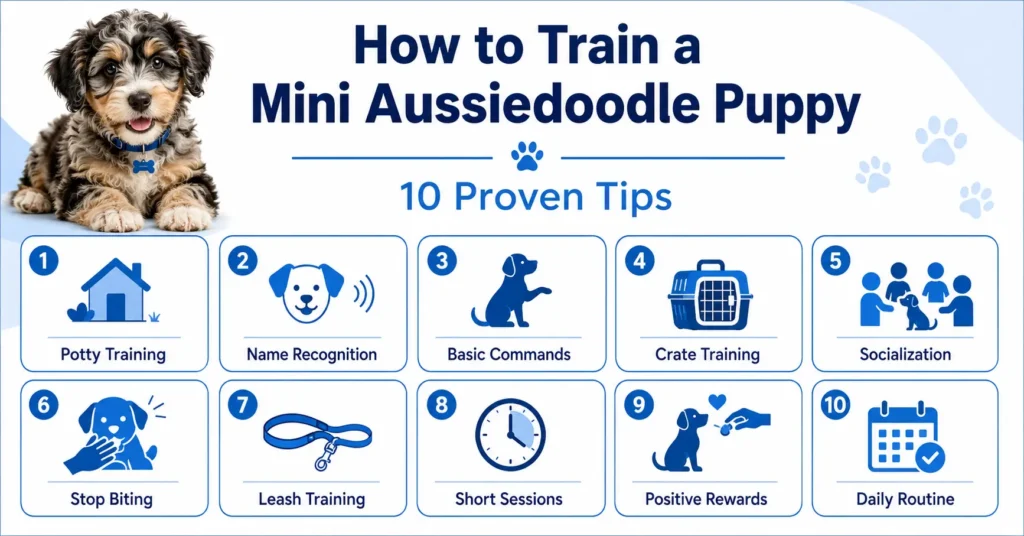
The table below gives a simple view of the main skills and when to practice them.
| Training Area | Best Time to Start | Main Goal | Useful Reward |
| Potty training | First day home | Toilet in one outdoor place | Treat and praise |
| Name response | First day home | Look toward the owner | Small food reward |
| Sit and touch | Eight weeks or older | Build focus and communication | Treat or toy |
| Recall | Indoors from the first week | Return when called | High-value treat |
| Crate training | First day home | Rest calmly in a safe space | Meal or chew |
| Socialization | During early puppyhood | Build safe confidence | Food and distance |
| Bite control | First play sessions | Choose toys instead of skin | Toy and continued play |
| Leash skills | After collar and harness practice | Walk without hard pulling | Food and sniffing |
Training should fit into normal life.
Ask for a sit before placing the food bowl down. Reward the puppy for following you into the yard. Give it a treat when it enters the crate on its own.
These small moments often teach more than one long formal session.
Mini Aussiedoodle potty training takes close supervision and a clear schedule.
A puppy does not understand that carpets and floors are off limits. It only knows that it needs to go. Your job is to take the puppy to the correct place before an accident happens.
Take the puppy outside after waking up and after eating and drinking. It may also need to go after play and training and naps.
Very young puppies need more frequent trips.
Carry the puppy outside when you think it may have an accident on the way. Use the same door and the same toilet area when possible.
Stand quietly and give the puppy time to sniff. Do not begin a game before it finishes.
The moment the puppy urinates or passes stool say a calm marker such as “yes.” Give a small treat right away. The reward should happen outdoors. Waiting until you return to the kitchen may make the lesson less clear.
A crate can support house training when it is the correct size. The puppy should have enough space to stand and turn around and lie down. A very large crate may allow it to use one end as a toilet area.
A puppy may need to go when it begins sniffing the floor or walking in small circles. It may leave a play session or move toward a corner.
Some puppies suddenly become restless.
Do not wait for whining at the door. That skill may take weeks to develop. Supervise the puppy when it is loose in the house. Use a leash indoors or keep it in the same room when needed. When you cannot watch closely, use a safe crate or puppy pen for a short time.
Do not punish an indoor accident.
The puppy may only learn that toileting near you feels dangerous. It may begin hiding behind furniture when it needs to go. Clean the area with an enzyme-based pet cleaner. Normal household cleaners may leave scent that attracts the puppy back to the same spot.
If you catch the puppy starting to go then interrupt gently and take it outside. Reward it when it finishes in the correct area. An accident usually means the schedule failed. It does not mean the puppy acted out of revenge.
A puppy that suddenly urinates very often or strains or seems uncomfortable needs a veterinary check.

Teaching basic commands and recall gives a Mini Aussiedoodle a way to understand you.
Begin in a quiet room. A kitchen full of people or a busy park makes learning much harder.
Train for three to five minutes. Stop before the puppy becomes tired or distracted.
Say the puppy’s name once.
When it looks toward you say “yes” and give a treat.
Do not repeat the name five times. Repeating it teaches the puppy that the first few calls do not matter. Practice when the puppy is close and not deeply focused on another activity.
The name should mean “look toward me.” It should not always predict the end of fun or a correction.
Hold a treat near the puppy’s nose. Move it slowly upward and slightly back.
As the puppy follows the food its bottom may touch the floor. Mark the moment and reward.
Do not push the puppy’s back end down.
For the touch cue, hold an open hand near the puppy’s nose. Most puppies will sniff it. Mark the nose contact and reward.
Touch becomes useful when you need to move the dog without grabbing its collar.
Recall means returning when called.
Start inside with only a few feet between you and the puppy. Say its name and then say “come” in a happy voice.
Move backward to encourage the puppy to follow.
Reward every successful response during early training. Use a high-value food reward when the environment becomes harder.
Never call the puppy and then punish it. Do not use recall only for baths or nail trimming or ending outdoor play.
Sometimes call the puppy and reward it before releasing it to play again. This prevents “come” from always meaning that fun is over.
A reliable recall can protect a dog during an emergency. Training should begin in easy settings before the owner adds distance and outdoor distractions.
Practice one or two skills in each session.
Do not drill every command at once. A Mini Aussiedoodle may learn quickly but still has a puppy brain and a short attention span.

Crate training a Mini Aussiedoodle puppy should create a safe resting place.
The crate should not feel like a punishment room.
Place it in a quiet family area at first. Add a safe mat or bedding when the puppy does not chew fabric. Keep water and temperature needs in mind.
Remove collars and harnesses during unsupervised crate time because they may catch on the crate.
Close the door for one or two seconds while the puppy eats. Open it before the puppy becomes worried.
Increase the time slowly.
Good crate training uses short sessions and positive associations. The crate should feel calm and safe rather than becoming a place where the puppy is left until it gives up crying.
A puppy may settle more easily after a toilet break and a little play.
Do not place a full-energy puppy into the crate and expect instant sleep.
Use the crate for naps and short rest periods. Place it near your bed during the first nights when that helps the puppy feel secure.
A young puppy may need a nighttime toilet trip.
Take it outside calmly. Avoid turning the trip into playtime. Return it to the sleeping area afterward.
A puppy may give a short protest because it wants to follow you.
Strong distress looks different.
Watch for heavy drooling or nonstop screaming or biting the crate. The puppy may throw its body against the door or refuse every food reward.
Do not continue increasing crate time when the puppy shows panic.
Persistent vocalizing and escape attempts can mean the training is moving too fast or the puppy feels distressed. Veterinary guidance recommends seeking help when a dog cannot settle safely in confinement.
A crate does not replace exercise or attention. A puppy should not spend most of its day locked inside.
Use a puppy pen or dog-safe room when it needs more space.
Puppy socialization and confidence building mean more than meeting many dogs.
Socialization teaches the puppy that normal life feels safe.
This includes people and surfaces and sounds and handling and travel. It also includes learning how to relax around other animals without greeting them.
Let the puppy watch new things from a safe distance.
It can see children playing or hear traffic without standing in the middle of the action.
Give treats when the puppy stays relaxed. Allow it to move away when it feels unsure.
Do not force the puppy into the arms of strangers.
A fearful puppy does not become confident because people keep touching it. It may become more worried.
The early socialization period matters. AVSAB supports safe and positive puppy socialization before the full vaccination series is finished when owners follow veterinary guidance and avoid high-risk locations.
Ask your veterinarian about local disease risk and safe puppy classes.
Let the puppy walk on carpet and tile and grass and safe metal surfaces.
Play recordings of storms or household sounds at a low volume. Pair the sound with food.
Practice gentle handling of paws and ears and the mouth.
Take short car rides that do not always end at the veterinary clinic.
Let the puppy observe people wearing hats and carrying bags. Introduce calm adults and respectful children one at a time.
Choose healthy and friendly dogs for meetings.
A wild group at a crowded dog park is not required for good socialization.
A confident puppy can notice something new and recover.
It does not need to rush forward.
When the puppy steps back from an object, give it time. Drop treats near the object instead of pulling the puppy closer.
Reward investigation.
Keep sessions short. One good experience is better than ten stressful ones.
Confidence grows when the puppy learns that it has choices and that the owner will protect it.
Stopping biting, jumping and chewing requires management and teaching.
Puppies explore with their mouths. Teething also creates a strong need to chew.
Do not expect a young Mini Aussiedoodle to ignore shoes and cables while they remain within reach.
Keep toys close during play.
When the puppy aims for your hand, place a toy between its mouth and your skin.
When biting becomes hard or repeatedly stops moving. End the game for a short moment.
Do not wave your hands or push the puppy away. Fast movement can make biting more exciting.
Many puppies become mouthier when tired.
After play, give the puppy a toilet break and calm rest with a safe chew. Veterinary behavior guidance recommends redirecting play biting toward suitable toys and adding downtime after active sessions.
Avoid hitting the muzzle or holding the mouth closed.
These actions can create fear of hands and handling.
Jumping often brings attention.
People look at the puppy and touch it or speak to it. The puppy learns that jumping works.
Ask visitors to wait.
Reward the puppy when all four paws remain on the floor. A sit can also earn greeting time.
When the puppy jumps, turn slightly away. Give attention as soon as it returns to the floor.
Use a leash during early greetings when needed.
Do not expect the puppy to stay calm when five excited people enter at once. Begin with one quiet visitor.
Puppy-proof the home.
Move shoes and remote controls and children’s toys. Cover electrical cables.
Use baby gates to block unsafe rooms.
Give different legal chewing options. Some puppies enjoy rubber toys. Others prefer soft toys or safe edible chews.
Rotate the toys so they feel interesting.
When the puppy picks up the wrong object, trade it for food or a toy. Do not chase it around the room.
Chasing may turn stealing into a game.
Supervision and a steady daily routine help prevent chewing habits before they become strong.
Leash training and a daily puppy routine help a Mini Aussiedoodle understand what happens next.
Predictable days can reduce toilet accidents and wild behavior.
A routine does not need to follow the exact minute. It should include food and sleep and toilet trips and play.
Let the puppy smell the collar or harness.
Place it on for a few seconds and give food. Remove it before the puppy becomes worried.
Slowly increase the time.
Check the fit. You should normally be able to place two fingers under the collar without making it loose enough to slip over the head.
A harness should not rub behind the front legs or block normal shoulder movement.
Attach a lightweight leash indoors while you supervise. Let the puppy feel it for a short time.
Never leave a leash dragging when nobody is watching.
Begin in a quiet room or yard.
Stand still and reward the puppy for staying near you. Take one step and reward again.
Keep the leash loose.
When the puppy pulls forward, stop walking. Wait for it to turn back or release the pressure.
Continue when the leash becomes loose.
Do not drag the puppy backward. Do not expect a strict competition heel.
The early goal is simple. The puppy should walk without pulling hard.
Reward it with food and chances to sniff.
Teaching basic cues and relaxed loose-leash walking can begin during puppyhood with short reward-based sessions.
Young puppies need a lot of sleep.
A puppy that runs and bites every evening may be overtired. Add a nap before adding more exercise. Use part of each meal for training. This prevents too many extra calories from treats. Change the routine as the puppy grows. Toilet breaks can become less frequent. Training can become slightly longer.
Keep some quiet time in the day even when the dog becomes an active teenager.

Mini Aussiedoodles learn fast. This means owner mistakes can also become habits quickly.
One common mistake is repeating cues.
The owner says “sit” five times. The puppy learns that it can wait for the fifth request.
Say the cue once. Use a hand signal or move to an easier place when the puppy cannot respond. Another mistake is training only when behavior goes wrong. Reward the puppy when it lies quietly. Reward it for walking past a shoe. Notice good behavior before it turns into trouble.
Some owners move too fast.
A puppy may come every time in the living room. That does not mean it is ready to run without a leash in a park. Add one challenge at a time. Increase distance or distraction but not both together.
Long training sessions also create problems. Stop after a few good repetitions. Let the puppy rest. The final mistake is expecting adult control from a baby dog. Progress will not move in a perfect line. Teething and growth and adolescence can create temporary setbacks.
Return to easier practice instead of becoming angry.
Training a Mini Aussiedoodle puppy starts with simple daily habits. Take the puppy outside often and reward toilet success. Teach its name and basic cues in a quiet room.
Build recall with high-value rewards. Never punish the puppy after it comes to you. Make the crate feel safe through meals and short rest sessions. Do not use it as a place for long isolation.
Socialize the puppy through calm and positive experiences. Let it observe new people and sounds without forcing contact. Redirect biting toward toys. Reward four paws on the floor. Keep unsafe objects out of reach.
Practice leash walking one or two steps at a time.
A Mini Aussiedoodle does not need a perfect trainer. It needs a patient person who uses clear rules and repeats them every day. Keep sessions short. Reward good choices. Give the puppy enough sleep.
Those small lessons will grow into useful adult habits.