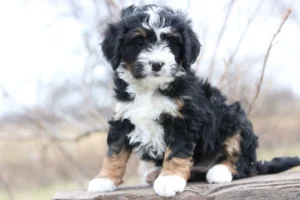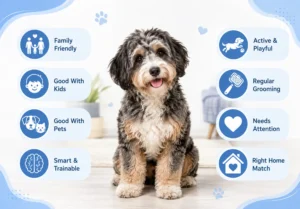

Mini Bernedoodles look like soft teddy bears. Their sweet faces make many people want to bring one home right away.
The truth is a little more complex.
A Mini Bernedoodle can be loving and clever and fun. It may become a loyal family companion that enjoys walks and training and quiet time on the couch. Yet this dog can also need costly grooming and daily attention. Some become clingy. Others bark or struggle when left alone.
A Mini Bernedoodle comes from a Bernese Mountain Dog and a Miniature Poodle. The Bernese Mountain Dog is known for its affectionate and good-natured personality. The Miniature Poodle is an active and highly intelligent dog. A puppy may inherit any mix of these parent traits.
This mix does not have one fixed coat or energy level. One Mini Bernedoodle may be relaxed and wavy-coated. Another may have tight curls and a much busier mind.
That is why owners should look past the cute photos.
Think about the dog’s whole life. It will need training and exercise and coat care and veterinary treatment. It will also need your time when the puppy stage becomes messy or tiring.
The table below gives a quick view of the main Mini Bernedoodle pros and cons.
| Thing to Consider | Possible Advantage | Possible Disadvantage |
| Temperament | Often affectionate and friendly | May become sensitive or needy |
| Size | Smaller than many standard Bernedoodles | Adult size can still vary |
| Intelligence | Usually learns new skills quickly | Can learn unwanted habits quickly |
| Exercise | Enjoys walks and family activities | Needs daily physical activity |
| Mental stimulation | Loves puzzles and training | Boredom may cause trouble |
| Grooming | Coat may look soft and attractive | Mats can form near the skin |
| Shedding | Some coats shed less | Low shedding is not guaranteed |
| Allergies | Some people react less to certain dogs | No dog is fully hypoallergenic |
| Health | Many live active family lives | Can inherit problems from either parent |
| Ownership cost | Care can be planned with a budget | Grooming and emergencies add expense |
| Family life | May bond well with children and pets | Supervision and socialization still matter |
| Time alone | Independence can be taught | Some develop separation distress |
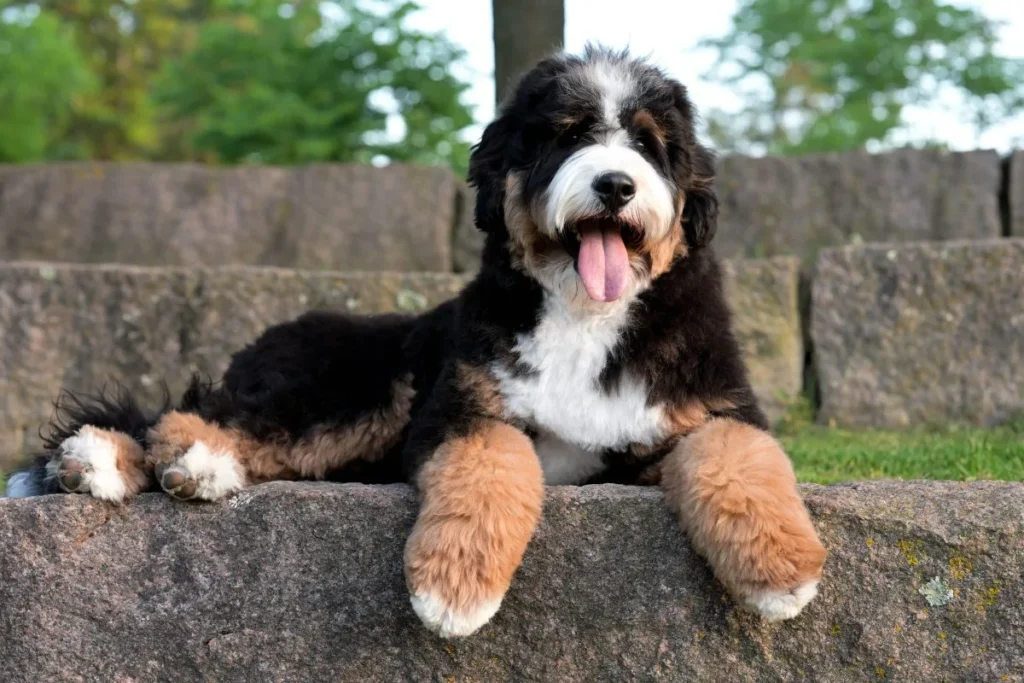
Many Mini Bernedoodles have a warm and people-focused personality.
The Bernese parent may pass on a gentle and affectionate nature. Bernese Mountain Dogs are described as sweet and good-natured. They often form strong bonds with their families.
The Poodle side may bring confidence and curiosity. Poodles are alert dogs that enjoy human company and active learning.
This mix can produce a dog that wants to be part of everything.
Your Mini Bernedoodle may follow you into the kitchen. It may lie beside your desk while you work. It may also greet family members with a full-body wag.
That close bond is a big advantage for owners who want an involved companion.
A close bond can sometimes become neediness.
Some Mini Bernedoodles want attention every time the owner sits down. A puppy may bark or paw or bring toys over and over.
Sensitivity can also appear.
A harsh voice may upset a soft-natured dog. Loud homes and rough handling may make a nervous puppy more worried. Temperament is never guaranteed by the name of a mix. Early socialization and health and parent temperament all play a part.
A responsible breeder should care about stable behavior as much as coat color. Meet the mother when possible. Ask how both parents act around visitors and children and unfamiliar sounds.
A Mini Bernedoodle may live in an apartment when the owner meets its needs.
A large yard is helpful. It is not a replacement for walks or training.
A dog can have access to a big yard and still become bored. It may bark at fences or dig holes because no one gives it a useful activity.
Apartment life can work when the dog receives regular toilet breaks and outdoor movement. The owner must also teach calm hallway and lift behavior. The dog should not rush toward neighbors or bark at every sound outside the door.
The word “mini” can create the wrong picture.
Mini Bernedoodles are usually smaller than standard Bernedoodles. Yet adult size can still vary because a large Bernese Mountain Dog is part of the family line.
The exact result depends on the parents and earlier generations. Two puppies from one litter may finish at different heights and weights.
Choose a crate and bed based on the expected adult dog rather than the tiny puppy in front of you.
Also think about lifting and travel. A heavier adult dog may become difficult to carry up stairs after an injury.
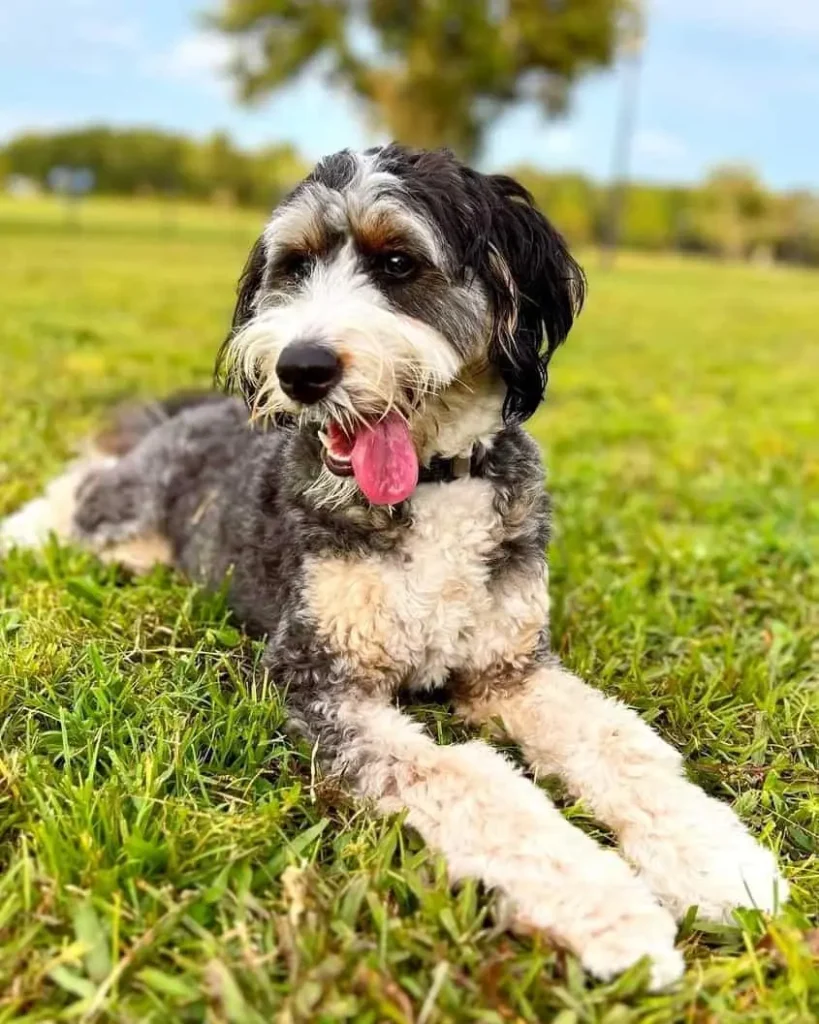
Mini Bernedoodles are often fast learners.
Poodles have a strong reputation for intelligence and trainability. Bernese Mountain Dogs can also learn well when owners use calm and steady guidance.
A Mini Bernedoodle puppy may learn to sit and touch and come within a short time.
This gives new owners a great start.
Use small rewards and clear cues. Keep lessons short. A few focused minutes can teach more than a long session that leaves the puppy bored.
The American Veterinary Society of Animal Behavior recommends reward-based training for normal skills and behavior problems. These methods use food and toys and play instead of fear or pain.
Intelligence has another side.
A clever puppy can learn that stealing socks starts a chase. It may learn that barking makes the owner open a door.
Dogs repeat actions that work.
Do not wait for a habit to become strong. Manage the home with gates and closed cupboards. Keep shoes and food out of reach.
Reward the behavior you want before trouble begins.
Teach practical skills such as waiting at doors and leaving dropped items. A strong recall and a calm mat cue also make daily life easier. Avoid repeating a cue many times. Say it once. Then make the task easier when the dog cannot respond.
A Mini Bernedoodle is not always a couch potato.
Bernese Mountain Dogs need regular moderate exercise. Poodles were developed as working retrievers and still enjoy physical activity.
A healthy adult Mini Bernedoodle may enjoy brisk walks and hiking and fetch. Some also like swimming or beginner dog sports.
Puppies need a different plan.
Their growing joints should not face long forced runs or repeated hard jumps. Let a puppy play at its own pace. Give rest when it slows down.
Exercise should suit the dog’s age and health.
A walk alone may not satisfy a smart dog.
Mental tasks help reduce boredom. Use food puzzles and scent searches and short training games. You can hide a few pieces of food around one room. You can also teach the names of toys or practice finding a family member.
Do not try to exhaust the dog through endless running.
That approach may create a very fit dog that needs even more exercise later. Mix faster activity with sniffing and training and quiet chewing. The dog should also learn how to rest. A good daily routine contains movement and thinking and calm recovery.
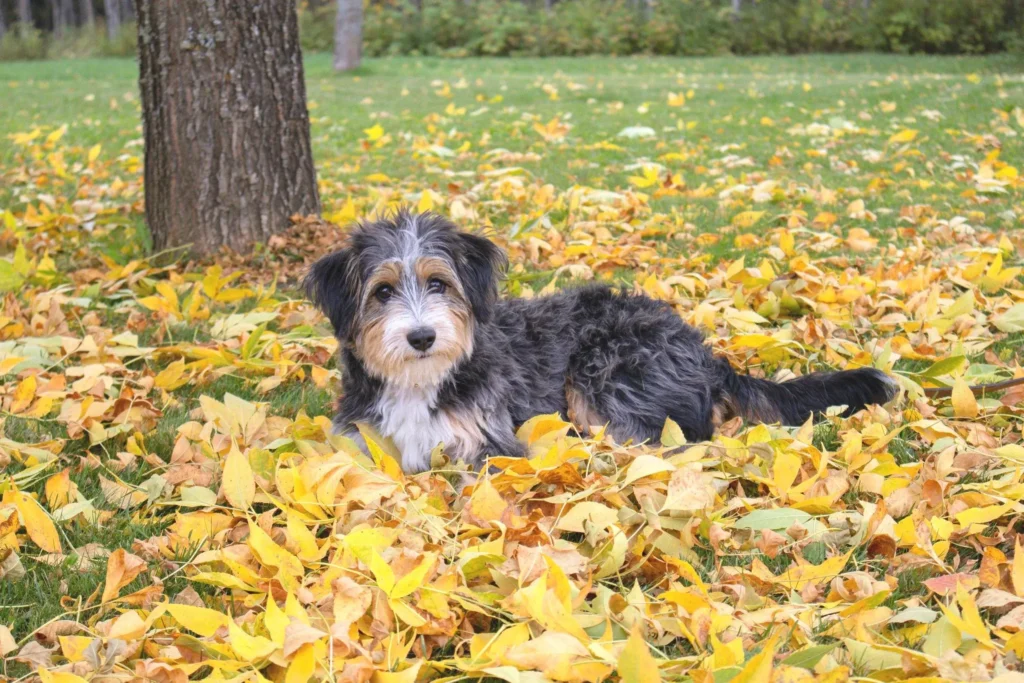
The soft coat is one of the main reasons people love Mini Bernedoodles.
It can also become one of the hardest parts of ownership.
A Mini Bernedoodle may inherit curly Poodle-style hair or a loose wavy coat. Some coats become thick around the ears and legs and tail. Long or curly coats can develop mats near the skin. Regular grooming keeps the hair clean and reduces tangles.
A quick brush over the back is not enough. Owners need to reach the hidden areas behind the ears and under the collar. The armpits and legs also tangle easily.
Many owners use a professional groomer every few weeks.
Poodle owners commonly choose professional clipping and bathing about every four to six weeks. The schedule for a Mini Bernedoodle depends on its coat length and texture.
Home care still matters between appointments.
Use a suitable brush and finish with a metal comb. The comb should pass through the coat without stopping.
Start handling practice during puppyhood. Touch the paws and ears and reward calm behavior.
A shorter haircut often suits active families better than a long teddy-bear style. Comfortable skin matters more than fluffy photos.
A curly Mini Bernedoodle may drop less visible hair than a Bernese Mountain Dog.
Loose hair can stay caught inside curls until brushing removes it. This may mean less hair on furniture.
Wavy and straighter coats may shed more.
The coat of a mixed-breed dog can be unpredictable. Even puppies in the same litter may have different textures.
Low shedding also does not mean low maintenance. Hair trapped in curls can form mats when it is not brushed out.
No Mini Bernedoodle is guaranteed to be hypoallergenic.
No purebred dog or mixed-breed dog is completely free from allergens. People can react to proteins found in dander and saliva as well as material carried on hair.
A person may react less to one individual dog and more to another.
Anyone with serious allergies should spend time with the specific dog when possible. A medical professional can also give personal advice before the family brings a puppy home.
Do not choose a puppy only because a seller promises a non-shedding or allergy-free coat.
Mixed breeding does not automatically remove health problems.
A Mini Bernedoodle may inherit health risks seen in Bernese Mountain Dogs. Responsible Bernese breeders screen for conditions such as hip and elbow dysplasia and some blood disorders and eye disease. Cancer is also an important concern in the Bernese breed.
This does not mean every Mini Bernedoodle will become ill.
It means owners should ask serious questions before buying a puppy.
Request proof of health tests for both parents. A simple veterinary check is not the same as full breeding health screening.
Miniature Poodles can carry risks related to their eyes and joints and blood clotting. Epilepsy and immune-related disorders may also occur in Poodle lines. Patellar luxation and Legg Calvé Perthes disease are more common concerns in smaller Poodle varieties.
A good breeder should explain which tests were completed and why.
Owners also need routine veterinary care after bringing the puppy home. Vaccines and parasite prevention and dental care remain important throughout the dog’s life.
Contact a veterinarian when you notice pain or limping or sudden behavior changes.

The puppy price is only the beginning.
Owners need to pay for suitable food and routine veterinary care. Vaccines and parasite prevention and dental treatment also belong in the long-term budget.
Then there is grooming.
A coat that needs professional clipping every few weeks can create a large regular expense. Training classes and boarding and dog walking may add more.
You will also need basic supplies such as a harness and leash and bed and bowls. Brushes and combs and toys and a crate add to the first-year cost.
Emergencies do not wait until the budget feels comfortable.
A dog may swallow a sock or hurt a leg or develop an illness. Emergency testing and surgery can become expensive.
The American Animal Hospital Association advises owners to plan for both expected care and unexpected treatment. Preventive visits can also find some problems before they become more difficult to manage.
Some families use pet insurance. Others build a separate savings fund.
The right choice depends on the household. The main point is to make a plan before an emergency happens.
Many Mini Bernedoodles love staying close to their people.
That bond feels wonderful until the dog cannot relax alone.
A puppy that follows the owner every minute may never practise independence. Then a sudden full workday alone can feel overwhelming.
Separation-related distress may include barking and pacing and panting. Some dogs damage doors or have toilet accidents when left. Others become anxious as soon as the owner picks up keys. True distress is not revenge or stubbornness. Punishment after returning home will not fix the fear.
Begin while the puppy is young.
Let it relax behind a gate while you remain nearby. Step out of sight for a few seconds. Return before the dog becomes upset.
Increase the time in small steps.
A camera can show what happens after you leave. Some dogs complain for a moment and then sleep. Others continue pacing or barking.
Severe separation problems need veterinary help. Treatment may involve careful behavior work and management. Some dogs may also need medication under veterinary direction.
A well-socialized Mini Bernedoodle can become a fun family dog.
Many enjoy gentle play and outdoor activities. Their affectionate nature may help them form strong relationships with children. Still a friendly dog can knock over a small child during excited play.
Puppies may also mouth hands or chase running feet.
Adults should supervise dogs around young children. Children need to learn not to disturb a dog while it sleeps or eats. The dog needs a quiet place where children cannot follow it.
Mini Bernedoodles can live with other dogs or cats when introductions happen slowly.
Early positive experiences can help. Yet each animal has its own personality and history.
Feed pets separately at first. Keep high-value chews away during early meetings.
Do not force animals to share beds or toys.
Watch for stiff posture or hard staring or guarding. A dog that growls is giving useful information. Move the animals apart instead of punishing the warning.
Peaceful distance counts as success. Pets do not need to cuddle to have a safe relationship.
A Mini Bernedoodle may bark because it hears a visitor or wants attention.
Boredom and fear and frustration can also cause noise.
The first step is finding the reason. A dog barking at a window needs a different plan from a dog barking when left alone.
For window barking use curtains or move the dog’s resting place. Reward quiet behavior when the trigger appears. For attention, barking waits for a short quiet moment before giving attention. Dogs should also learn calm crate or pen time through gradual and positive practice.
Young Mini Bernedoodles may jump on guests or steal objects. Chewing and puppy biting are also common.
Management makes training easier.
Use gates and closed doors. Keep unsafe objects away. Give the dog legal chew toys before it chooses furniture. Adolescent dogs may seem to forget earlier training. This is normal development for many young dogs.
Return to easier practice. Use better rewards and shorter sessions.
Seek professional help when behavior includes serious fear or aggression or self-injury. Choose a trainer who uses reward-based methods.
A Mini Bernedoodle may suit you when you enjoy an active and social companion.
The strongest reasons to choose one include:
The best owner does not need to be perfect.
The dog needs someone who can stay patient and follow a routine.
A Mini Bernedoodle may not suit every household.
Think carefully when:
A responsible choice protects both the owner and the dog.
Waiting for a better time can be kinder than bringing home a puppy that does not fit your daily life.
Mini Bernedoodles have many real advantages.
They are often affectionate and smart and fun to train. They can become close family companions. Some also shed less than heavier-coated breeds.
The challenges deserve equal attention.
Their coats may mat. Grooming can cost a lot over time. Daily exercise and mental stimulation are necessary. Some dogs also become clingy or noisy without proper training.
Health cannot be guaranteed by mixing two breeds. Ask for health testing from both parent lines. Choose temperament and responsible breeding before color.
Take time to study your schedule and living space and budget.
A Mini Bernedoodle may be the right dog when you want an active and loving partner. It becomes a poor match when you expect a low-maintenance teddy bear.
The cutest puppy still grows into a real dog with real needs.