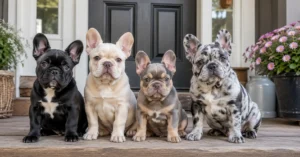
Fluffy French Bulldogs have the same bat ears, short face, compact body, and playful nature seen in regular Frenchies. The clear difference is their hair. Instead of a short smooth coat, they grow longer and softer fur.
This unusual coat raises many questions.
Are Fluffy French Bulldogs really purebred? Did another breed create the long hair? Can two short-haired French Bulldogs produce a fluffy puppy? Can a fluffy Frenchie receive kennel club papers?
The answers are not always as simple as online sellers make them sound.
A long-haired French Bulldog can come from purebred French Bulldog parents. Long hair is linked with hidden coat genes that can pass through several generations. Still, a fluffy coat does not match the traditional French Bulldog show standard.
Registration also does not prove that a dog has perfect health or follows every part of the breed standard. It mainly records parentage based on the registry’s rules and documents.
Buyers should look beyond coat length and rare colors. Breathing, spine health, eyes, knees, heart, skin, and the breeder’s choices matter much more.
| Question | Simple Answer |
| Can a fluffy Frenchie be purebred? | Yes, when it comes from purebred French Bulldog bloodlines |
| Is it a separate breed? | No |
| What causes the fluffy coat? | Recessive coat-length genes |
| Can smooth parents have fluffy puppies? | Yes, when both pass a long-hair gene |
| Does the coat meet the normal show standard? | No, the standard calls for a short smooth coat |
| Does registration prove good health? | No |
| Is coat DNA testing enough? | No, health screening is also needed |
| Are fluffy Frenchies always mixed? | No, coat length alone cannot prove mixing |
| Should rarity control the price? | Health and responsible breeding should matter more |
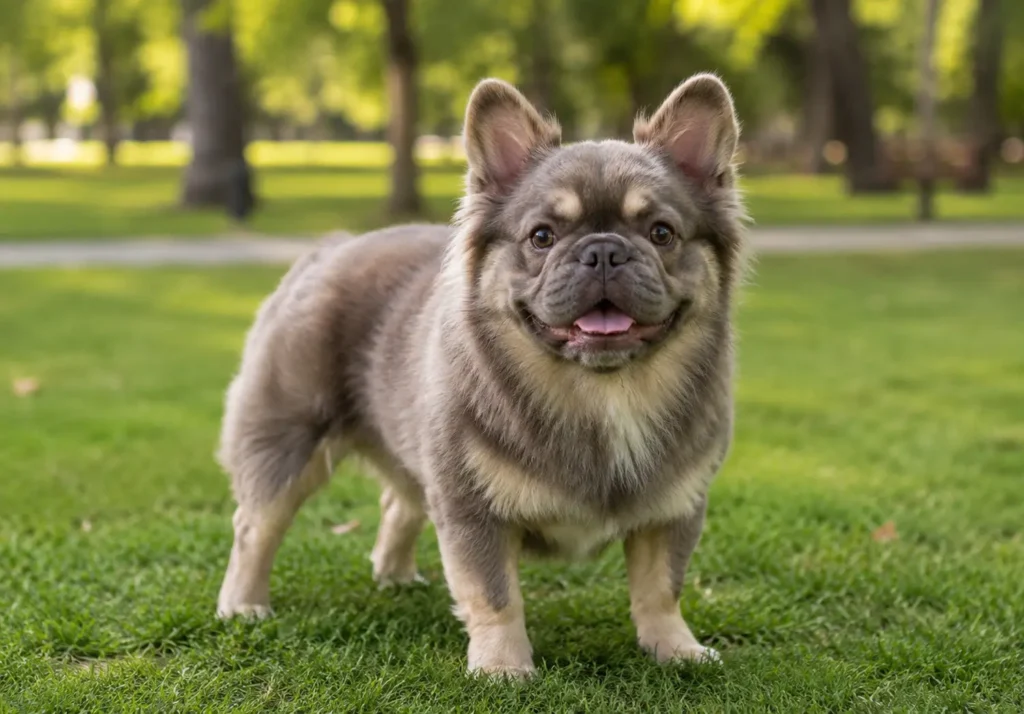
A purebred dog comes from parents that belong to the same breed and have a recorded family line. Coat length alone does not decide whether a dog is purebred.
A fluffy Frenchie may be born from two French Bulldog parents. If the family line contains the needed long-hair genes, a puppy can grow a fluffy coat without a recent cross with another breed.
This surprises many people because the common French Bulldog has very short hair.
The words purebred and breed standard do not mean the same thing.
A dog may come from purebred parents but still have a feature that does not match the written show standard. The feature might involve coat length, color, size, markings, or another body trait.
The traditional French Bulldog standard describes a smooth and short coat. A fluffy coat falls outside that preferred appearance. This can affect success in conformation shows even when the dog’s family records list French Bulldogs.
A family pet does not need to win a show to be loved. Still, sellers should explain the difference honestly.
No. A fluffy Frenchie is not a separate breed.
Names such as long-haired French Bulldog, fluffy Frenchie, teddy Frenchie, and rare fluffy Bulldog are often used in advertisements. They describe the dog’s look. They do not create a new official breed.
Some breeders may try to make the coat sound more special by using fancy terms. Buyers should not pay a huge amount only because a seller uses the word rare.
A photo cannot prove that a dog is purebred.
Many small breeds can have upright ears, short faces, or fluffy coats. A dog may look like a Frenchie while having another breed in its family line.
The opposite can also happen. A true French Bulldog may have an unusual coat and make people think it is mixed.
Pedigree records and carefully chosen DNA tools can provide more information. Even then, buyers should understand the limits of each test.
A good breeder should clearly explain:
Be careful when a seller says a dog is fully approved without explaining what that means.
Approved for registration, suitable for breeding, and eligible to win in a breed show are different claims.
Genes carry instructions that help shape a dog’s body. They affect coat length, coat color, size, and many other features.
Long hair in dogs is linked with changes in a gene called FGF5. Several versions of this gene can cause a longer coat.
One long-hair variant has been found in French Bulldogs. The fluffy trait usually acts as a recessive trait. This means a puppy generally needs a long-hair copy from both parents to show the coat.
Each puppy receives genetic information from both parents.
For a simple example, think of each parent giving one coat-length card.
A puppy may receive:
A dog with one short and one long copy may look smooth-coated. It can still carry the hidden long-hair copy.
A dog that receives the needed long-hair copy from both parents may grow a fluffy coat.
Real genetics can be more detailed than this example, but the basic idea helps explain why the trait can remain hidden.
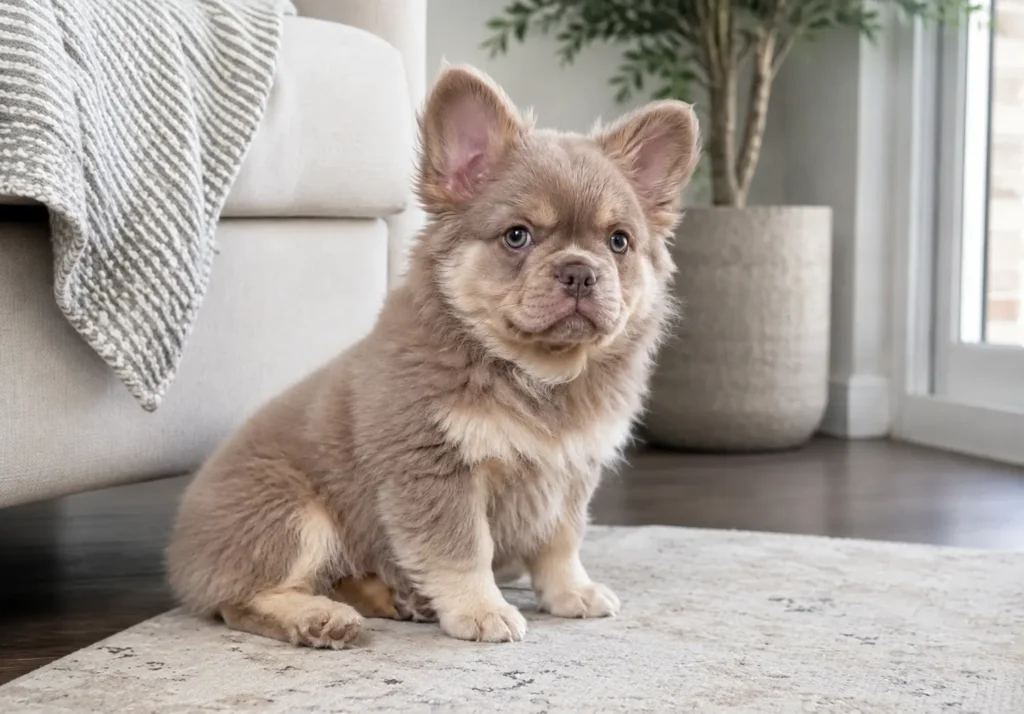
A carrier has a long-hair gene but may not look fluffy.
The dog can pass that gene to its puppies.
This is why a family may produce only smooth puppies for several generations. Later, two carriers may be paired and a fluffy puppy appears.
The coat did not suddenly come from nowhere. The hidden gene may have traveled quietly through the family line.
Coat length does not decide the whole personality.
A fluffy Frenchie may be calm, playful, shy, bold, friendly, or stubborn. Temperament comes from many genes and life experiences.
Early handling, training, health, socialization, and the behavior of the parents all play a part.
Do not believe a seller who claims that fluffy Frenchies are always calmer, smarter, sweeter, or healthier only because of their hair.
The coat-length gene itself should not be treated as proof that the dog is sick.
The bigger health concern is how breeders select parents.
A breeder who focuses only on rare hair and color may ignore breathing, movement, spine shape, eye health, and family history.
A fluffy dog can have good or poor health. The same is true for a smooth Frenchie.
Good breeding requires much more than producing a rare coat.
Yes. Two smooth-coated French Bulldogs can produce fluffy puppies when both parents carry a compatible recessive long-hair variant.
The parents may look like regular Frenchies. The gene stays hidden because each parent also has a short-coat copy.
When both parents pass the long-hair copy to the same puppy, that puppy may grow longer fur.
Imagine that both parents are carriers.
Each puppy has a chance of receiving one coat gene from the mother and one from the father.
Some puppies may receive two short-hair copies. These dogs usually have short coats and do not carry the fluffy gene from that pairing.
Some may receive one short and one long copy. They often look short-haired but can carry long hair.
Others may receive a long-hair copy from both parents. These puppies may grow fluffy coats.
This is a chance for each puppy. It does not mean every litter will contain an exact set number of coat types.
Yes.
A litter may contain one fluffy puppy and several smooth puppies. Another litter from the same parents may contain no fluffy puppies.
Genes pass to each puppy separately. The result can change from litter to litter.
A fluffy puppy strongly suggests that both parents gave the needed long-hair genetic information.
A DNA coat test can help confirm the coat status of the parents and puppy.
However, correct parentage must also be known. A coat test cannot prove the full family tree on its own.
Before easy DNA testing became common, breeders could not always see hidden coat genes.
A smooth dog looked like any other smooth Frenchie. There was no clear outside sign that it carried long hair.
A fluffy puppy might appear after many years without one. People sometimes assumed that an unknown cross must have happened.
Modern coat testing gives breeders a better way to understand the hidden trait.
The coat result should not be the only concern.
Before breeding, both dogs should receive proper health screening. Their breathing, movement, structure, temperament, and family history should also be considered.
Producing fluffy puppies should never be more important than producing dogs that can breathe, move, and live comfortably.
DNA testing can provide useful information about coat length. A laboratory can examine specific parts of the dog’s genetic material and report which tested variants were found.
The result may show that a dog has short-hair copies, carries a long-hair variant, or has two copies linked with a fluffy coat.
A good coat test may help answer questions such as:
UC Davis lists several recessive FGF5 variants connected with long hair in dogs and identifies one variant in French Bulldogs.
A coat test checks certain variants linked with hair length.
A breed ancestry test compares the dog’s DNA with reference groups used by that company. Results can vary because companies may use different databases and methods.
An ancestry result may provide useful clues. It should not automatically replace a verified pedigree from a trusted registry.
A seller should not use one screenshot from a commercial test as proof of every claim about the dog.
Parentage testing compares genetic markers from the puppy with markers from the claimed mother and father.
This can help confirm that the listed dogs are the biological parents.
Parentage testing does not tell you that the parents are healthy. It also does not decide whether every feature matches the breed standard.
Do not rely only on a cropped image sent through social media.
Ask for:
When possible, check results through the laboratory or health registry.
A responsible breeder should not become angry when a serious buyer asks for proof.
Registration can confuse new buyers.
A registered dog has been entered into a kennel club’s record system under that club’s rules. Registration usually connects the dog with recorded parents.
It does not mean that the dog has passed every health test. It also does not promise perfect structure or behavior.
The AKC describes the French Bulldog as having a short, smooth coat. The breed page also lists the expected coat length as short. A long coat does not match that normal show description.
This matters in conformation competition. Judges compare dogs with the written standard.
A fluffy Frenchie may still be a loved pet. Its coat simply differs from the traditional look expected in the show ring.
A puppy can have registration papers and still develop health problems.
Registries record ancestry and ownership information. They do not personally raise each litter or watch every breeder every day.
The buyer must still check health testing, living conditions, veterinary care, and the breeder’s reputation.
Kennel clubs and registries have different rules.
One organization may accept records that another organization does not. Some small registries offer papers easily and have limited checks.
The name of a registry matters. Ask what the papers allow and how the parents were recorded.
Do not assume that any certificate with a logo has the same value as a long-established kennel club record.
Rules depend on the event.
A dog that does not match the conformation coat standard may not succeed in a traditional breed show. Other dog activities may have different entry rules.
French Bulldogs can take part in activities such as obedience, scent work, rally, or other suitable events when their health allows it.
The dog’s breathing and comfort should always come first.
Show quality means a breeder believes a puppy closely fits the breed standard and may have potential for conformation competition.
Pet quality does not mean poor quality or unhealthy. It often means the puppy has a feature that makes it less suitable for showing.
A longer coat can place a Frenchie outside the normal show look.
A pet-quality puppy still deserves careful breeding, health testing, proper care, and an honest contract.
A fluffy French Bulldog faces many of the same health risks as a smooth Frenchie.
The longer coat does not remove problems linked with the breed’s short face and compact body.
Buyers should pay close attention to breathing, heat safety, spine health, knees, eyes, skin, and heart health.
French Bulldogs have short skulls and flat faces. This body type is called brachycephalic.
Some dogs have narrow nostrils, a long soft palate, or other airway problems. They may breathe loudly even while resting.
Warning signs include:
Do not accept severe breathing trouble as normal for the breed.
A Frenchie should be able to rest, walk, play lightly, and sleep without fighting for air.
Dogs cool themselves mainly by panting.
A short airway can make cooling harder. French Bulldogs may overheat quickly in warm or humid weather.
Walk during cooler hours. Keep fresh water available and provide an air-conditioned indoor space in hot weather.
Never leave a Frenchie inside a parked car.
Longer hair may add some warmth, but the short airway remains the main concern.
French Bulldogs can have unusual vertebrae or disc problems.
A dog with back pain may refuse stairs or cry when lifted. It may shake, walk stiffly, or avoid jumping.
Sudden weakness in the back legs needs emergency care.
Keep the dog at a healthy weight. Use steps or a ramp near furniture to reduce repeated jumping.
Kneecap and hip problems can affect movement.
Watch for limping, skipping steps, stiffness, or reluctance to exercise.
Health screening of breeding dogs can provide useful information. It cannot prevent every future problem, but it helps breeders make better choices.
The French Bull Dog Club of America has used CHIC health screening recommendations that include areas such as hips, kneecaps, and eyes, with other testing also recommended.
Frenchies have large and open eyes.
Dust, rough play, and plants can scratch the eye surface. A dog may squint, rub its face, or keep one eye closed.
Eye trouble can become serious quickly. Contact a veterinarian when the eye looks red, cloudy, painful, or produces heavy discharge.
The face folds can trap moisture, food, and dirt.
Clean them gently and dry them well. Redness, smell, or sticky discharge may point to an infection.
A fluffy coat can hide skin trouble. Brush the dog and check beneath the fur for sores, flakes, bald spots, and lumps.
Frenchies may also develop allergies that cause itching, paw licking, and ear infections.
The French Bull Dog Club of America encourages health testing and uses OFA databases to help breeders make informed breeding decisions. Its breeder referral requirements include CHIC screening for breeding dogs.
Ask for real results rather than accepting phrases such as vet checked or health guaranteed.
A basic puppy examination is helpful, but it is not the same as breed-specific screening of both parents.
A responsible breeder cares more about healthy puppies than rare coats.
The breeder should speak openly about the good and difficult parts of French Bulldog ownership.
Be careful with sellers who talk only about color, coat, price, and breeding rights.
A good breeder usually:
The French Bull Dog Club of America has a breeder referral process with health and club requirements. This can be one useful starting place, though every buyer should still do personal checks.
Walk away when a seller:
A cute video should never replace proper documents.
The mother can give clues about health and temperament.
She should appear comfortable around her puppies. She may be protective, but she should not look extremely weak, dirty, or unable to breathe.
Check how she walks and listens to her breathing at rest.
The father may live somewhere else. Ask for his records and contact information for his owner when suitable.
Puppies need more than food and a clean box.
They should hear normal home sounds and experience gentle handling. They need safe contact with people and suitable surfaces.
Ask whether the puppies have started simple grooming, nail handling, and crate practice.
A puppy raised with no activity may struggle after entering a busy home.
Read the full contract before paying.
It should explain registration, health terms, return rules, breeding limits, and the responsibilities of both sides.
Look for clear language about what happens if a serious health condition appears.
A health guarantee does not mean much when the rules make it almost impossible to use.
The purchase price is only the beginning.
A Frenchie may need regular skin care, dental work, allergy treatment, eye care, or airway treatment.
Pet insurance may help with future bills. Read the plan carefully because existing problems may not be covered.
Keep an emergency fund even with insurance.
A rare fluffy coat should never leave the owner unable to pay for medical care.
Use this list when speaking with a breeder:
A serious breeder should welcome careful questions.
A dog can be purebred and still come from poor breeding.
Purebred status only tells part of the story. It does not guarantee clear breathing, good movement, stable behavior, or a long life.
The best breeder does not ask only whether two dogs can produce fluffy puppies.
The breeder asks whether the dogs should be bred at all.
Good breeding looks at health, temperament, body structure, family history, and genetic variety. Coat length comes after those points.
Fluffy French Bulldogs can be purebred when they come from French Bulldog parents and a true French Bulldog family line.
The long coat can result from recessive FGF5 genetics. Two smooth-coated carriers may produce a fluffy puppy even when neither parent has long hair.
A fluffy coat still falls outside the normal short and smooth look described in the traditional French Bulldog standard. This affects show appearance but does not automatically prove that the dog is mixed.
DNA coat testing can explain hair length. It cannot replace health testing, parentage records, or a trusted pedigree.
Look beyond the soft coat and rare color. Ask about breathing, spine health, knees, eyes, heart checks, and the breeder’s history.
A responsible breeder provides proof and answers questions without pressure. That matters far more than any label such as rare, exotic, or pure fluffy.