

A Mini Aussiedoodle may need anywhere from about 300 to 1,100 calories each day as an adult. The right amount depends on its weight and age and activity level.
That is a wide range. Mini Aussiedoodles do not all grow to the same size. One adult may weigh 12 pounds. Another may weigh more than 30 pounds.
The food itself also makes a big difference.
One cup of dry food may contain 330 calories. Another cup may contain 450 calories. Two dogs can need the same calories but eat a different number of cups.
This is why a simple answer like “feed two cups every day” does not work for every dog.
Start with your dog’s current weight. Check the calorie amount printed on the food bag. Then watch the dog’s waist and ribs over the next few weeks.
The feeding guide on the package gives a starting point. It is not a perfect rule. Some dogs need a little less. Active dogs may need more.
Healthy adult dogs often need about 1.4 to 1.8 times their Resting Energy Requirement. Puppies need more energy for growth. These formulas only give an estimate. The dog’s real body condition should guide the final amount.
Choose food marked complete and balanced for the correct life stage. Puppy food should support growth. Adult food should support adult maintenance. Treats and toppers usually do not provide complete nutrition by themselves.
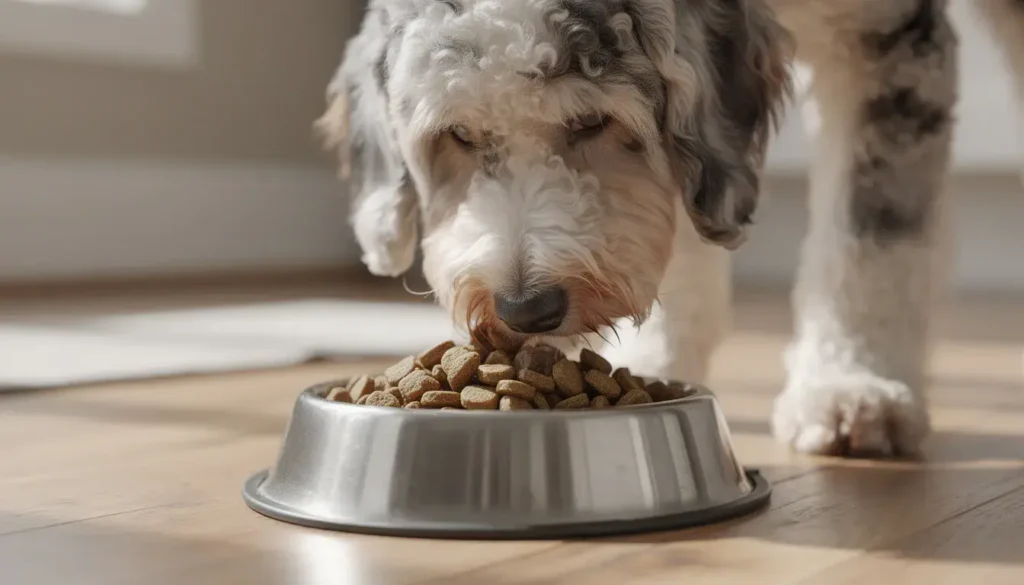
A Mini Aussiedoodle’s food needs change quickly during its first year.
A small puppy needs more calories for each pound of body weight than an adult dog. It uses that energy to build bones and muscles and organs.
The puppy still has a small stomach. Several small meals work better than one large meal.
A Mini Aussiedoodle between eight and twelve weeks old usually needs three or four small meals each day.
Feed a complete puppy diet. Use the same food the breeder or rescue used during the first few days when possible.
A sudden change can upset the puppy’s stomach.
Measure the entire daily amount in the morning. Divide that food between breakfast and lunch and dinner. A very small puppy may need a fourth small meal.
Do not refill the bowl every time it becomes empty.
Free feeding makes it hard to know how much the puppy has eaten. It can also make toilet training less predictable.
Take the puppy outside shortly after eating. Regular meals help you learn when it needs to use the bathroom.
Most puppies in this stage do well with three meals each day.
The daily portion may rise as the puppy gains weight. Do not increase it only because the puppy looks hungry.
Mini Aussiedoodles are smart. Some learn that staring at the bowl brings more food.
Check the puppy’s body every week.
You should feel the ribs under a thin layer of fat. You should also see a gentle waist when looking down from above.
Puppies should grow at a steady rate without becoming round or heavy. Measured meals make it easier to control growth and adjust portions.
Many Mini Aussiedoodles can move to two meals each day between six and twelve months.
Some still feel better with three smaller meals. This can work well when the dog eats too fast or seems uncomfortable after a larger meal.
Growth begins to slow during this stage.
The puppy may still act hungry because it enjoys food. Hunger-like behavior does not always mean the dog needs more calories.
Count training treats as part of the daily food.
You can remove a small amount of kibble from breakfast and use it during recall training or leash practice later in the day.
Most healthy adults do well with two measured meals each day.
The exact time does not matter as much as keeping a steady routine.
One meal can come in the morning. The second can come in the evening.
Avoid feeding the full daily amount in one large meal. Two meals feel easier on the stomach and give the dog something to look forward to twice a day.
Veterinary feeding guidance commonly recommends at least two daily meals for adult dogs. Puppies may need two to four meals depending on age and size.
Older dogs may need fewer calories when they become less active.
Not every senior dog needs less food. Some lose muscle or weight due to dental pain or health problems.
Do not cut food only because the dog reached a certain birthday.
Watch its body shape and energy. Ask a veterinarian about unexplained weight gain or weight loss.
Weight gives you a better starting point than the Mini Aussiedoodle name.
Veterinary teams often begin with the Resting Energy Requirement formula:
RER = 70 × body weight in kilograms raised to the power of 0.75
They then multiply the answer based on age and activity and reproductive status.
A neutered healthy adult may start near 1.6 × RER. An obesity-prone dog may start closer to 1.4 × RER. An intact or more active adult may need around 1.8 × RER.
| Current Weight | Lower-Calorie Adult | Typical Neutered Adult | More Active Adult |
| 10 pounds | About 305 kcal | About 350 kcal | About 390 kcal |
| 15 pounds | About 415 kcal | About 470 kcal | About 530 kcal |
| 20 pounds | About 510 kcal | About 585 kcal | About 660 kcal |
| 25 pounds | About 605 kcal | About 690 kcal | About 780 kcal |
| 30 pounds | About 695 kcal | About 795 kcal | About 895 kcal |
| 35 pounds | About 780 kcal | About 890 kcal | About 1,000 kcal |
| 40 pounds | About 860 kcal | About 985 kcal | About 1,110 kcal |
These numbers are only starting estimates for healthy adult dogs.
Do not use this adult table for a growing puppy or a pregnant dog or a dog with diabetes or kidney disease. Those dogs need a plan from a veterinarian.
Find the calorie statement on the food package.
It may say:
400 kcal per cup
Imagine that your dog needs 690 calories per day.
Divide 690 by 400.
The answer is about 1.7 cups each day.
You could feed about 0.85 cup in the morning and 0.85 cup in the evening.
Now imagine another food contains only 345 calories per cup.
The same dog would need about two cups of that food.
This shows why cup amounts change between brands.
A kitchen scale gives a more accurate amount than a large plastic scoop.
One person may fill a cup lightly. Another may pack it to the top.
Those small differences can add many extra calories over a month.
Measure wet food too. Count every can or pouch as part of the daily total.
When you mix wet and dry food do not feed the full recommended amount of both. Replace some dry-food calories with wet-food calories.

Puppies and adult dogs do not have the same nutritional needs.
A puppy needs energy for growth. It also needs the correct balance of protein and minerals and vitamins.
Adult food may not provide the right nutrition for a young growing dog.
Healthy puppies younger than four months may need about three times RER.
Puppies older than four months may start near two times RER until growth slows. These numbers should be adjusted through regular weight and body-condition checks.
This does not mean you should let the puppy eat as much as it wants.
Too many calories can make the puppy gain fat faster than its frame should carry it.
A gently lean puppy is usually healthier than a heavy puppy.
Look for a nutritional statement that says the food is complete and balanced for growth or all life stages.
Do not choose food only because the package shows a cute puppy.
Read the small nutritional statement.
Products labeled only for adult maintenance are not designed as the main diet for a growing puppy. Life-stage labels help owners choose food made for the dog’s current needs.
Many small or medium dogs change to adult food near the end of the first year.
The best time depends on the dog’s expected adult size and growth rate.
Some smaller dogs mature earlier. Larger Mini Aussiedoodles may need puppy food for longer.
Ask your veterinarian when the dog approaches adult size.
Change the food slowly over 7 to 14 days. Begin with mostly old food and a small amount of new food. Increase the new food little by little.
A slow change lowers the chance of vomiting or loose stool.
A good feeding schedule should feel simple.
You do not need to feed at the exact same minute every day. Try to keep meals within the same general morning and evening periods.
This helps the dog understand its routine.
It also makes changes in appetite easier to notice.
This is only a basic plan.
A very young puppy may need another small meal. An adult dog with a health issue may need a special schedule.

Measured feeding lets you track appetite.
You can tell when the dog suddenly eats less. You can also see how much food remains after each meal.
A bowl that stays full all day hides this information.
Measured meals also help with weight control. You can lower or raise the daily amount in small steps.
Some Mini Aussiedoodles finish food in less than a minute.
Use a slow-feeder bowl or puzzle feeder. You can also scatter measured kibble across a clean feeding mat.
Do not add extra food just to fill a large puzzle toy.
Use food from the dog’s normal daily portion.
Two Mini Aussiedoodles can weigh the same but need different calories.
One may spend most of the day sleeping indoors. The other may hike and train in dog sports.
Activity matters. Owners still often overestimate it.
A short walk does not always make a dog highly active.
A Mini Aussiedoodle may need fewer calories during injury recovery or very hot weather.
Older dogs may also move less.
Start near the lower end of the calorie range when the dog gains weight easily.
Do not make a huge cut at once.
Reduce the daily amount by about five to ten percent. Watch the body for two to four weeks before making another change.
Many family dogs fit into this group.
They receive daily walks and some play or training. They still rest for much of the day.
The typical neutered-adult estimate may provide a reasonable starting point.
The dog’s waist will tell you whether that amount works.
A dog that hikes often or trains in agility may burn more calories.
Working dogs may need more food during busy weeks.
Increase the portion slowly when the dog begins losing weight or looking too lean.
Do not add hundreds of calories because of one long walk.
Look for a pattern across several weeks.
Some dogs need fewer calories after being spayed or neutered.
The surgery itself does not force a dog to become overweight.
Weight gain happens when the dog eats more calories than it uses.
Check body weight before surgery and again during recovery. Adjust food when the waist begins to disappear.
Treat calories count.
A dental chew or spoon of peanut butter may contain more calories than you expect.
Table scraps also count even when they look small.
Veterinary guidance commonly recommends that treats and extras provide no more than 10 percent of daily calories. At least 90 percent should come from complete and balanced food.
A dog eating 600 calories per day should receive no more than about 60 treat calories.
That amount can disappear quickly.
Set aside some of the dog’s measured breakfast.
Use that kibble for sit and recall and leash training.
The dog still earns rewards. You avoid adding many extra calories.
Save high-value treats for difficult situations.
Cut soft treats into very small pieces. The dog cares more about receiving a reward than receiving a large chunk.
One person may give a biscuit in the morning.
Another family member may share food at lunch. Children may offer several treats after school.
Each person thinks the dog received only a small amount.
Together those snacks can equal another meal.
Place the daily treat allowance in one container each morning. When it becomes empty the dog has finished its treats for the day.
Weigh your Mini Aussiedoodle every two to four weeks when possible.
Use the same scale.
Small changes are easier to correct than large ones.
A five-percent portion adjustment may be enough when you catch weight gain early.
The empty bowl does not prove the dog needs more food.
Many healthy dogs eat quickly and still look for more.
Judge the portion by body condition and weight and energy.
Run your hands along the sides of the chest.
You should feel the ribs without pressing hard. They should have a light fat covering.
Look down from above. A healthy dog should have a visible waist behind the ribs.
Look from the side. The belly should rise gently toward the back legs.
The WSAVA body-condition chart describes an ideal dog as having ribs that are easy to feel and a visible waist and abdominal tuck.
Contact a veterinarian when appetite or weight changes suddenly.
Do not keep reducing food when the dog loses weight without a clear reason.
Parasites and dental disease and digestive problems can affect appetite and weight.
The front of a food bag may use words like premium or natural.
Those words do not tell you whether the food provides complete nutrition.
Read the nutritional adequacy statement and calorie content.
Both dry and wet foods can provide complete nutrition when properly made.
Wet food contains more water. It may have fewer calories in each cup because much of the product is moisture.
Dry food is easy to measure and use during training.
You can combine them. Count calories from both types.
A homemade diet needs careful planning.
Chicken and rice with vegetables may look healthy. It may still lack important calcium and vitamins and other nutrients.
This becomes especially risky for a growing puppy.
Ask a board-certified veterinary nutrition specialist to create a complete recipe when you want to feed homemade food.
Do not use a random recipe as the puppy’s main diet.
Keep clean water available throughout the day.
Wash the water bowl often. Refill it after exercise and during warm weather.
A sudden major increase in drinking may signal a health problem.
How much should a Mini Aussiedoodle eat each day?
Start with age and current weight. Read the food label to find calories per cup or can. A small adult may need around 300 to 400 calories. A larger or more active Mini Aussiedoodle may need 900 calories or more.
Puppies need more calories for each pound because they are growing. They also need complete puppy food made for growth. Feed young puppies several small meals. Most healthy adults do well with two measured meals.
Keep treats under ten percent of daily calories. Check the ribs and waist every few weeks. Do not depend only on the number printed on the food bag. Measure the food. Watch the body. Adjust the amount slowly. Your Mini Aussiedoodle’s shape and energy will show whether the portion is working.