Mini Bernedoodles can be funny little guys. They’re playful, smart, fluffy, and usually pretty attached to their people. But that cute teddy-bear look can make it easy to forget something important. They can still develop health problems.
A Mini Bernedoodle usually comes from Bernese Mountain Dog and smaller Poodle lines. That mix means a puppy can inherit health risks from either side of the family. It doesn’t mean every Mini Bernedoodle will get sick. Plenty stay active and healthy for years. Still, knowing what to watch for makes a big difference.
Joint trouble is one area worth watching. Smaller dogs can also have kneecap problems. Skin allergies, eye disease, stomach trouble, and inherited conditions may show up too. Some are mild. Others need long-term care.
Don’t get hung up on every tiny symptom. A dog scratching once isn’t automatically allergic. A puppy slipping on a smooth floor doesn’t mean hip dysplasia. Look for patterns. If the same problem keeps showing up, that’s when it deserves a closer look.
| Health Issue | Signs You May Notice | When It May Show Up | What Helps |
| Hip dysplasia | Limping, stiff walking, trouble getting up | Young or adult dogs | Healthy weight, vet checks, controlled exercise |
| Joint problems | Pain, slower movement, less jumping | Any age | Low-impact activity and early care |
| Patellar luxation | Skipping on one back leg | Often younger dogs | Vet exam and weight control |
| Skin allergies | Itching, red skin, paw licking | Any age | Find the trigger and treat the skin |
| Eye problems | Cloudy eyes, bumping into things | Depends on the condition | Eye exams and early testing |
| Digestive trouble | Vomiting, diarrhea, gas | Any age | Stable diet and veterinary care |
| Genetic disease | Depends on the disease | Puppyhood to older age | Parent testing and routine exams |
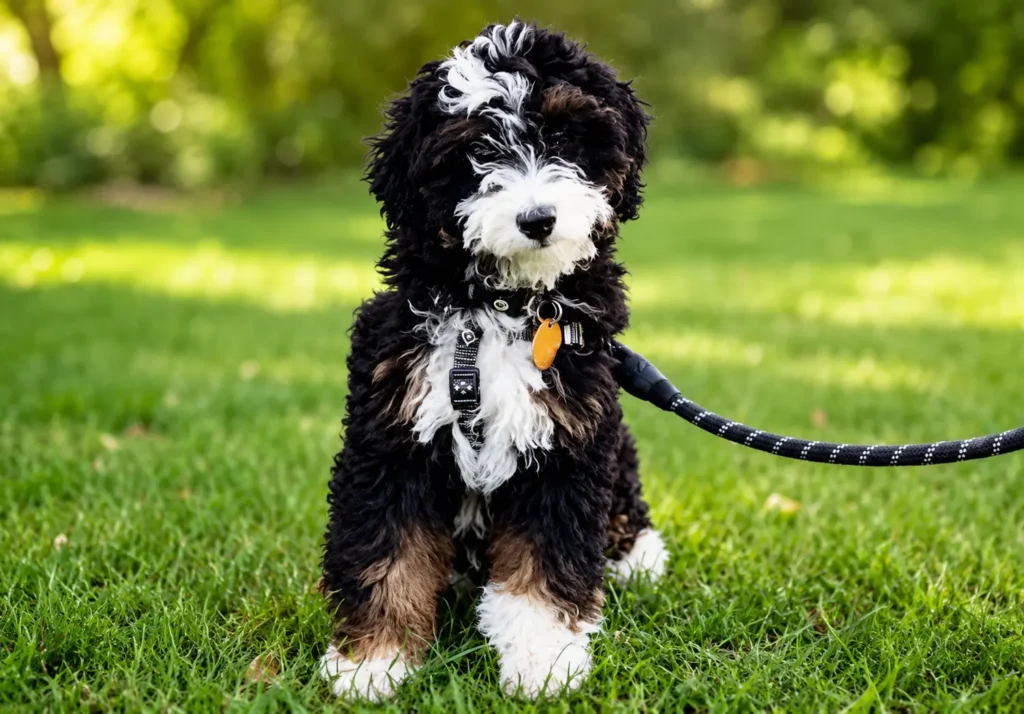
Hip dysplasia sounds like a problem only giant dogs get, but it can affect many sizes of dogs and crosses. The hip joint doesn’t fit together as well as it should. Over time that loose movement can wear the joint down and lead to pain or arthritis.
A Mini Bernedoodle may inherit risk from the Bernese side or the Poodle side. Size matters a bit, but genetics matter too.
A young dog with hip trouble may not always look sick.
Some dogs do a funny bunny-hop when running. Both back legs move together instead of one at a time. Others struggle to get up after sleeping.
You might notice your Mini Bernedoodle doesn’t want to jump into the car anymore. Stairs suddenly look like hard work. Long walks that used to be fun may end with slow steps and stiffness.
Other clues include:
Those signs can come from other injuries too. So don’t try to diagnose hip dysplasia just by watching the dog walk.
Puppies grow fast. Sometimes it feels like they grow overnight.
Good nutrition matters during this stage. Feeding way too much can make a puppy gain weight faster than its joints need.
Keep the puppy lean rather than chunky. You should be able to feel the ribs without pushing hard. A little waist behind the ribs is usually a pretty good sign that weight is under control.
Exercise matters too.
A puppy needs movement. Keeping it still all day isn’t healthy. But hours of hard running, repeated high jumps, and slipping around on smooth floors isn’t a great setup either.
Normal walks, gentle play, sniffing, and controlled activity are usually easier on growing joints.
Tile and polished wood can throw a young dog off the scent, so to speak.
The paws slide outward while the puppy runs. That doesn’t cause every joint problem, but giving the dog better grip makes daily movement easier.
Rugs or washable runners can help in busy areas.
Keep nails trimmed too. Long nails change how a dog places its feet.
The number on the scale is important, but it’s not the only thing.
Body condition matters more than chasing one perfect weight.
Extra pounds put more load on sore hips and knees. A Mini Bernedoodle doesn’t need to look skinny. It just shouldn’t carry a heavy layer of fat over the ribs and waist.
If the dog is already limping, don’t suddenly start a hard exercise plan to make it lose weight. Talk with a vet and reduce calories in a sensible way.
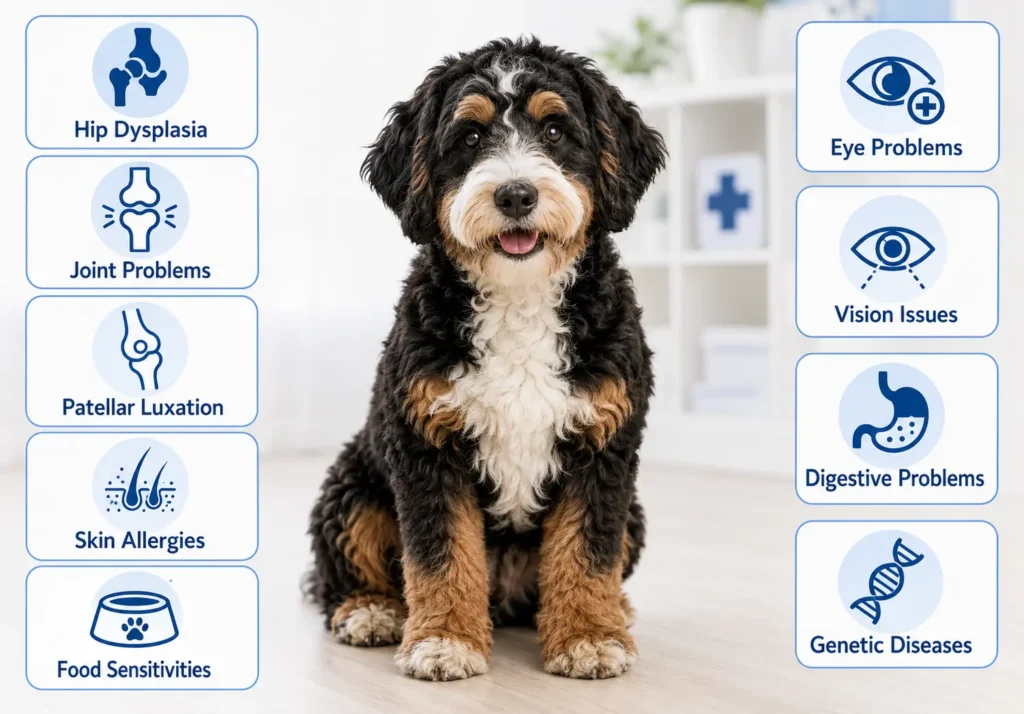
Patellar luxation is a fancy name for a kneecap that slips out of its normal groove.
It’s seen more often in smaller dogs, including Miniature Poodles, so it’s something worth knowing about in smaller Bernedoodle mixes.
Sometimes the kneecap pops out and quickly slides back. In more serious cases it stays out or keeps slipping again and again.
One classic sign is a little skip.
The dog runs normally. Then one back leg suddenly lifts for two or three steps. A moment later the leg comes down and the dog keeps going like nothing happened.
That can look harmless. And in mild cases it may not cause much trouble at first.
Still, repeated skipping should be checked.
You may also notice stiffness, limping, reluctance to jump, or a strange kick of the back leg.
Patellar luxation has different grades.
A mild case may only need monitoring, healthy weight, and sensible exercise. A dog with repeated pain or a kneecap that stays out may need more treatment.
Surgery can be considered in serious cases.
The important bit is this: don’t wait until the dog barely uses the leg.
An early exam gives you more information. It also lets the vet check whether another knee or hip problem is involved.
There’s no magic trick that guarantees perfect knees.
You can still make daily life easier.
Keep the dog lean. Avoid letting an unfit puppy launch itself off tall beds all day. Use steps or a ramp if your dog constantly jumps from high furniture.
Build muscle with normal walks and gentle play.
Good muscle support around the legs can help the whole body move better.
A fluffy coat can hide a lot.
You may not see red skin right away because all that curly or wavy hair sits over it. Sometimes the first thing you notice is nonstop scratching.
Mini Bernedoodles may develop skin or food-related problems just like their parent breeds and other dogs. Reported signs in Bernedoodles include itching, skin irritation, ear trouble, and stomach symptoms.
Paw licking is easy to miss.
A dog settles on the floor and chews between its toes for ten minutes. Then it does the same thing later that night.
Keep a close eye on that.
Allergies may also cause:
The dog may scratch more after going outside. That can point toward something in the environment.
Other dogs react all year.
Food trouble doesn’t always cause dramatic vomiting.
A sensitive dog may have soft poop now and then. There may be gas. Ear problems keep coming back. The paws stay itchy.
That can be frustrating because owners often start changing food every week.
Try not to do that.
Constant food changes make it harder to work out what the dog actually handles well.
If a vet suspects a food reaction, a controlled diet trial may be recommended. That means feeding one planned diet for a set period and cutting out random treats and table scraps.
It’s boring, sure. But boring is useful when you’re trying to find a trigger.
Brush through the coat down to the skin.
Don’t just brush the fluffy top layer.
Check behind the ears, under the front legs, around the belly, and between the toes. These spots can get damp or tangled.
Mats pull on the skin and can trap dirt.
Dry the dog well after baths or swimming. Damp skin under thick hair is a nice little home for irritation.
Those dark Bernedoodle eyes are expressive, but eye health deserves attention too.
Bernedoodles can potentially inherit eye conditions from their parent lines. Progressive retinal atrophy is one condition linked with gradual vision loss, and Miniature Poodles are among breeds for which eye and PRA testing is recommended.
Progressive retinal atrophy affects the retina.
It slowly reduces vision and can eventually cause blindness.
Early on, a dog may seem fine during the day but act unsure at night.
It may stop at dark stairs. It might bump into a chair that was moved. Walking into a dark room suddenly takes more courage.
The dog may hesitate outside after sunset.
Later, vision can become worse during daylight too.
Not every cloudy-looking eye means the same disease.
Changes can happen for several reasons. Cataracts are one possibility. Injury and inflammation can change the way an eye looks too.
If one eye becomes red, cloudy, swollen, or painful, get it checked.
Squinting matters.
A dog holding one eye shut isn’t just making a funny face. Eye pain can get serious fast.
Dogs often adjust pretty well to slow vision loss.
Keep furniture in familiar places. Use gates near dangerous stairs if needed.
Talk before touching the dog while it sleeps. A dog that can’t see well may jump when a hand suddenly appears.
Keep food and water in the same area.
On walks, a leash gives extra security.
Don’t let blindness fool you into thinking the dog can’t enjoy life. Many blind dogs still play, sniff around, learn routes, and stay close to their families.
Some Mini Bernedoodles seem to have stomachs made of steel.
Others? One bite of something weird and the whole day changes.
Vomiting, soft stool, diarrhea, gas, and poor appetite can happen for many reasons. Food changes are common triggers. Parasites, infections, swallowed objects, stress, and longer-term digestive disease may cause similar signs.
So the pattern matters.
Switching food overnight can upset a sensitive stomach.
A better approach is usually to change gradually over several days.
Start with mostly the old food and a little of the new food. Slowly increase the new amount.
If poop turns soft, slow down.
Don’t add five new treats while changing the main diet. You’ll have no clue what caused the problem.
Table food can create trouble too.
Greasy scraps are especially rough on some dogs. Bones, wrappers, toys, socks, and other swallowed objects are a different issue entirely and can create an emergency.
One vomit after eating something silly may pass.
Repeated vomiting is another story.
Get help sooner if your dog can’t keep water down, becomes very weak, has blood in vomit or stool, or develops a swollen painful belly.
Repeated dry retching with little coming up can also be a serious warning sign.
Don’t wait around hoping it fixes itself if the dog looks really uncomfortable.
Boring can be good for a sensitive stomach.
Use a complete food that agrees with your dog. Measure it instead of guessing.
Keep treats modest.
If the dog gulps food like it hasn’t eaten in a week, a slow feeder can stretch the meal out.
Fresh water should always be easy to reach.
If stomach trouble keeps returning, write down what the dog ate. That little food diary can be surprisingly useful.
A Mini Bernedoodle is a mix, but mixing two breeds doesn’t wipe every inherited problem away.
A puppy can still receive disease-related genes from either parent. Bernese Mountain Dogs have known concerns that include hip and elbow dysplasia, some cancers, blood disorders, and eye disease. Miniature Poodles have their own concerns, including patellar luxation, hip problems, and progressive retinal atrophy.
That’s why parent testing matters.
PRA causes the light-sensing cells in the retina to slowly stop working.
There isn’t one simple outward test you can do at home before symptoms begin.
Genetic testing and proper eye exams can help breeders understand risk before producing puppies.
Ask to see results rather than accepting “parents are healthy.”
Healthy-looking and health-tested are not the same thing.
Von Willebrand disease affects blood clotting.
An affected dog may bleed longer after an injury or surgery. Nosebleeds or unusual bleeding can happen in some cases.
Different forms exist in dogs.
DNA testing is useful for certain breeds and variants, but testing should match the actual parent breed and disease risk rather than using one giant test panel and calling everything clear.
Degenerative myelopathy is a late-onset nervous system disease.
It can cause weakness in the back legs and slowly worsen over time.
Some Bernese Mountain Dog lines carry known genetic risk variants. A positive risk result does not mean a dog will definitely become sick, which is why these test results need proper interpretation.
Cancer is an important concern in Bernese Mountain Dogs.
That does not mean every Mini Bernedoodle will develop cancer.
A crossbred dog receives a different mix of genes. Individual risk depends on much more than the breed label.
Still, family history is useful.
Ask whether parents, grandparents, or close relatives developed serious cancer at a young age.
That kind of information can tell you something a simple puppy photo never will.
DNA tests are useful. They’re not magic.
Hip structure needs proper joint evaluation. Kneecaps need a physical exam. Eyes may need examination by an eye specialist.
The Miniature Poodle side has recommended screening that includes hips, patellas, eye examination, and PRA-prcd DNA testing.
A breeder saying “DNA clear” while skipping physical health tests is only giving you part of the picture.
There’s no way to promise that a dog will never get sick.
Still, daily care stacks the odds in the right direction.
Start with weight. A lean dog carries less extra load on the hips and knees. You should be able to feel the ribs. The belly should pull up a little behind them.
Then look at exercise.
Mini Bernedoodles are usually active enough to enjoy walks, games, training, and sniffing. They don’t need to be run into the ground.
A pretty good routine may include:
Puppies may need shorter activity sessions and more sleep.
Older dogs often do better with steady low-impact movement rather than sudden hard exercise.
Every week or so, have a little nose-to-tail check.
Feel for lumps while brushing.
Look between the toes. Smell the ears. Check whether the eyes look clear.
Run your hands down both back legs and notice if the dog pulls away.
Watch it walk across the room.
These tiny checks don’t replace a vet exam. They simply help you notice when something has changed.
Small and medium dogs can develop dental trouble.
Brush the teeth with dog toothpaste. Human toothpaste isn’t made for dogs.
Start slowly.
Let the puppy lick a tiny amount from the brush. Then work up to a few teeth.
Dental chews can help a bit, but they don’t replace proper brushing and veterinary dental care.
A young healthy dog may look perfect on the outside.
A vet can listen to the heart, check joints, examine the eyes, feel the belly, look at the teeth, and track weight over time.
Older Mini Bernedoodles may benefit from blood and urine checks based on their age and health history.
Keep vaccine and parasite prevention schedules suited to where you live.
Don’t copy another dog’s medical routine just because both dogs are Bernedoodles. Their age, lifestyle, size, and local disease risk may be different.
This part matters a lot if you’re getting a puppy.
Mini Bernedoodles can be produced from different Poodle sizes and different generations of crosses. So there isn’t one tiny test list that fits every possible pairing.
Ask what exact breeds are behind your puppy.
For a Miniature Poodle parent, useful recommended screening includes hip evaluation, patella evaluation, an eye examination, and testing for PRA-prcd. Bernese Mountain Dog breeding lines also need attention to hips, elbows, eyes, and other breed-related conditions.
Ask to see the real results.
A sentence saying “vet checked” isn’t enough.
Also ask about the health of grandparents and previous litters. A clean DNA test is useful, but family history can add another layer.
Dogs have off days. That happens.
Still, call a vet when something clearly isn’t right.
Get advice if your Mini Bernedoodle develops ongoing limping, repeated vomiting, long-lasting diarrhea, strong skin itching, repeated ear problems, or sudden vision changes.
Seek faster care for serious signs such as collapse, trouble breathing, a swollen painful belly, inability to stand, major bleeding, seizures, or sudden paralysis.
Also pay attention to personality changes.
A friendly dog that suddenly snaps when its back is touched may be hurting.
Pain can show up as behavior before anything else looks wrong.
Don’t choose only by color.
That fluffy tri-color puppy may be adorable. Sure. But the health paperwork matters more than the markings.
Ask about both parents.
Look at how they move and breathe. Ask about allergies, joint trouble, eye disease, cancer history, seizures, and early deaths in the family.
A careful breeder should know these things or at least be willing to discuss them.
Avoid anyone who says mixed dogs can’t have genetic disease.
That simply isn’t how genes work.
Crossing two breeds may change risk, but inherited problems can still pass to puppies.
Mini Bernedoodle health issues can include hip dysplasia, kneecap trouble, allergies, eye disease, stomach problems, and inherited conditions from the Bernese Mountain Dog or Poodle side.
Don’t let that list scare you into thinking every Mini Bernedoodle is unhealthy. It doesn’t work that way.
Look at the individual dog.
Keep it lean. Give it steady exercise. Brush through that thick coat and actually check the skin underneath. Watch the knees and hips as the puppy grows. Keep an eye on the eyes, ears, poop, appetite, and energy too.
Most of all, take repeated changes seriously.
A little limp after one wild play session may be nothing. Limping every week is different. One soft poop can happen. A month of stomach trouble needs a closer look.
Good parent testing, routine veterinary care, sensible food, and everyday observation go a long way. It’s not fancy. It’s just good dog care, and for these fluffy little guys, that matters a lot.
The research mainly supported the parent-breed risks, joint disease, patellar luxation, eye disease, and health-testing sections. Hip dysplasia involves joint looseness that can lead to arthritis, while patellar luxation is especially common in smaller dogs.