

A Mini Bernedoodle may eat around 300 to 1,100 calories per day as an adult. The actual amount depends on body weight and age and activity level. That range sounds large because Mini Bernedoodles do not have one fixed adult size. One may weigh 12 pounds. Another may reach 35 or 40 pounds.
Food also differs between brands.
One dry food may contain 330 calories in one cup. Another may contain more than 450 calories in the same cup. This means two dogs can need the same number of calories but receive a different number of cups.
The best feeding plan uses three things:
Your dog’s current weight. The calories in the food. The dog’s body condition. A feeding chart on the bag gives you a useful starting point. It should not become a permanent rule. Some Mini Bernedoodles need less than the printed amount. Others need a little more.
Veterinary calorie formulas also provide a starting estimate. They still need adjustment based on the dog’s growth and body shape and health.
Choose a food labeled complete and balanced for your dog’s life stage. Puppy food should support growth. Adult food should support adult maintenance. The nutritional adequacy statement on the package tells you which life stage the food is designed for.
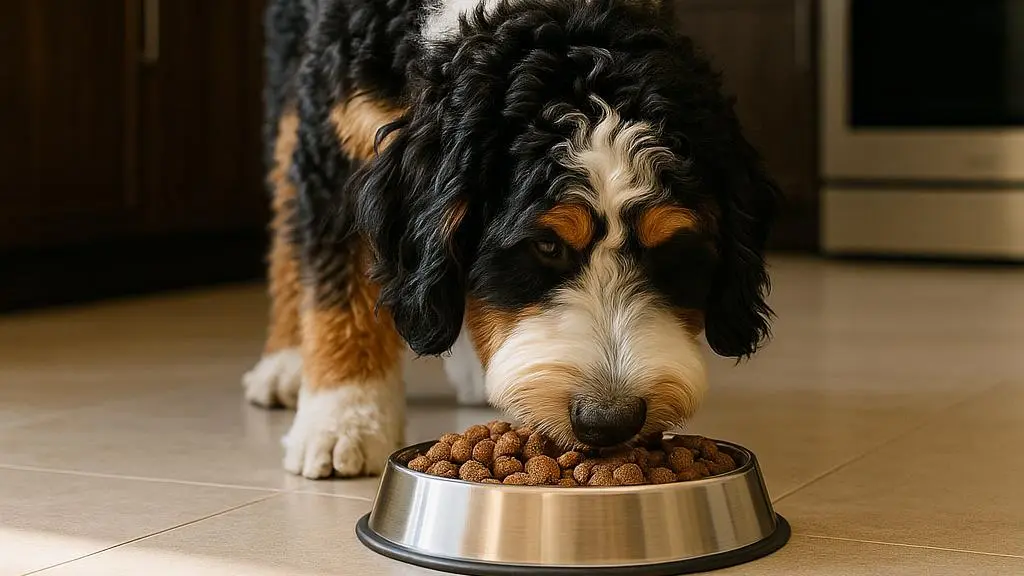
A Mini Bernedoodle’s food needs change quickly during the first year.
A growing puppy needs more calories for each pound of body weight than an adult. It uses that energy to build muscles and bones and organs.
The adult may weigh more and eat more total food. Yet it usually needs fewer calories for each pound.
A young Mini Bernedoodle puppy has a small stomach.
It often does better with three or four small meals instead of one or two large meals. Regular meals also make toilet training easier because young puppies often need to go outside shortly after eating.
Use the puppy food that the breeder or rescue group has been feeding at first. A sudden food change may cause loose stool or vomiting.
Measure the full daily amount in the morning. Divide it between the planned meals.
Do not keep filling the bowl every time it becomes empty. Free feeding can make it hard to track the puppy’s appetite and daily calorie intake.
Most puppies in this stage can eat three measured meals each day.
Their total food amount may rise because their bodies are getting bigger. Do not increase the portion only because the puppy acts hungry.
Mini Bernedoodles are smart dogs. Some quickly learn that staring at the kitchen or carrying the empty bowl gets attention.
Check the puppy’s waist and ribs before adding more food.
You should feel the ribs under a light layer of fat. You should also see a gentle waist behind the ribs when looking down from above.
Many Mini Bernedoodles can move to two meals per day during this period. Some still do better with three smaller meals. The growth rate begins to slow. The dog may not need food increases as often as it did during early puppyhood.
This stage can be tricky because the dog looks active and always seems ready to eat. Adolescence also brings more training. Count training food as part of the daily amount. Set aside some kibble before breakfast and use it during the day.
Many small and medium mixed dogs move from puppy food to adult food near the end of their first year. The correct timing depends on expected adult size and growth.
Ask your veterinarian before making the switch.
Puppy food contains nutrition designed for growth. Feeding it long after growth finishes may give some dogs more calories than they need.
Change food slowly over 7 to 14 days. Start with mostly old food and a small amount of new food. Add more new food over several days. Slow down when the dog develops vomiting or loose stool or poor appetite.
A healthy adult Mini Bernedoodle usually does well with two measured meals per day.
Older dogs may need a different calorie amount because their activity and muscle mass can change. Senior does not automatically mean the dog needs less food.
Some older dogs gain weight because they move less. Others lose weight because of dental disease or illness.
A sudden weight change deserves veterinary attention.
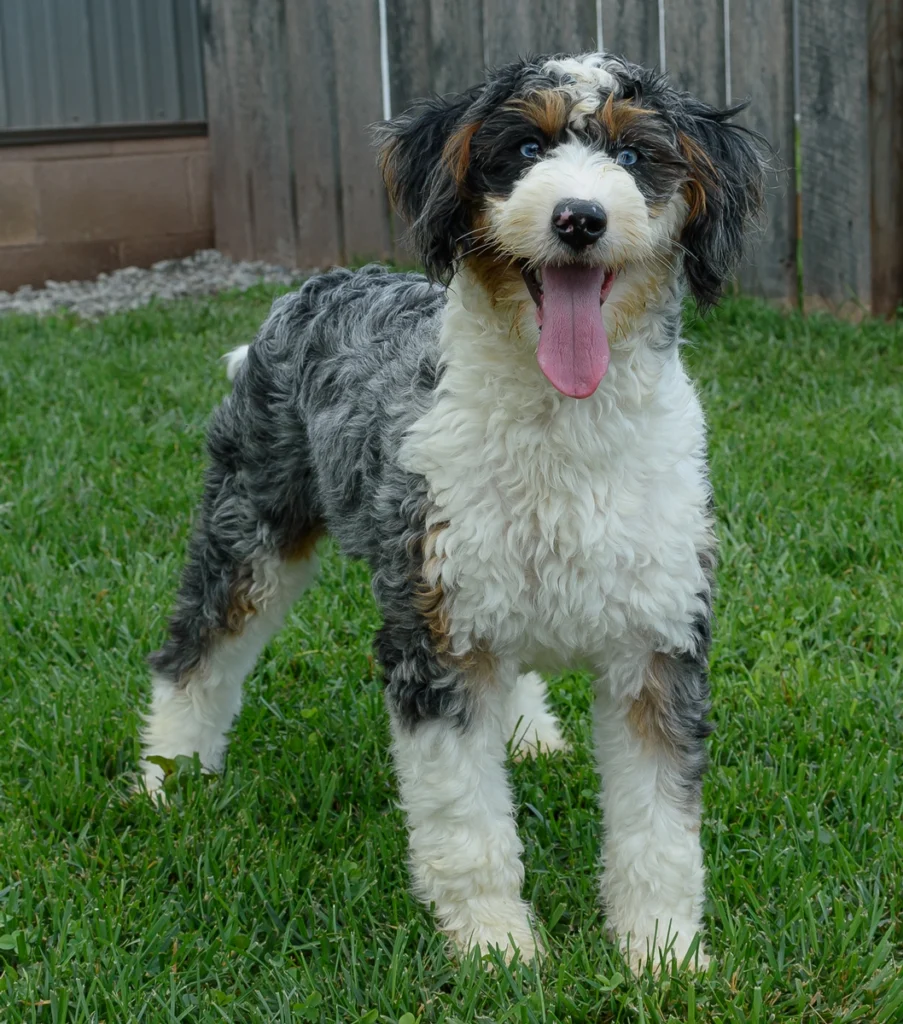
Weight gives you a better starting point than the words “Mini Bernedoodle.”
Veterinary teams often estimate calorie needs with the Resting Energy Requirement formula:
RER = 70 × body weight in kilograms raised to the power of 0.75
A multiplier is then used for life stage and activity.
Merck Veterinary Manual lists about 1.4 × RER for an obesity-prone adult dog. It lists 1.6 × RER for a neutered adult and 1.8 × RER for an intact adult.
These numbers are estimates. A real dog may need more or less.
| Current Weight | Lower Adult Starting Point | Typical Neutered Adult | More Active or Intact Adult |
| 10 lb or 4.5 kg | About 305 kcal | About 350 kcal | About 390 kcal |
| 15 lb or 6.8 kg | About 415 kcal | About 470 kcal | About 530 kcal |
| 20 lb or 9.1 kg | About 510 kcal | About 585 kcal | About 660 kcal |
| 25 lb or 11.3 kg | About 605 kcal | About 690 kcal | About 780 kcal |
| 30 lb or 13.6 kg | About 695 kcal | About 795 kcal | About 895 kcal |
| 35 lb or 15.9 kg | About 780 kcal | About 890 kcal | About 1,000 kcal |
| 40 lb or 18.1 kg | About 860 kcal | About 985 kcal | About 1,110 kcal |
These estimates apply to healthy adult dogs. Do not use them as a fixed prescription for a growing puppy or pregnant dog or a dog with a medical condition.
Look for the calorie content on the package.
It may say something such as:
400 kcal per cup
Imagine that your Mini Bernedoodle needs about 690 calories per day.
Divide 690 by 400.
The answer is about 1.7 cups per day.
You could divide that amount into two meals of about 0.85 cup each.
Now imagine another food contains 340 calories per cup.
The same dog would need about two cups to receive close to 690 calories.
This is why a general answer such as “feed two cups” may be wrong. Cups only make sense after checking the calorie density.
A kitchen scale gives a more accurate portion than a large plastic scoop. Kibble pieces differ in shape and size. One loosely filled cup may contain less food than one packed cup.
Puppies need enough energy to grow. They do not need unlimited food.
Fast growth and excess body fat can place extra pressure on developing joints. A slow and steady growth pattern is healthier than trying to make the puppy grow as quickly as possible.
Merck uses about three times RER as a starting point for healthy puppies younger than four months. It uses about two times RER after four months. These values still need adjustment based on growth and body condition.
Puppy food is not simply adult food with more calories.
A complete growth diet provides nutrients in amounts meant for a growing dog. The label should state that the food supports growth or all life stages.
Do not feed a young puppy a food labeled only for adult maintenance unless a veterinarian has given a specific reason.
The FDA explains that growth and adult maintenance have different nutritional profiles because growing dogs do not have the same needs as adult pets.

A healthy puppy should not look round and heavy.
You should feel the ribs without pressing hard. The puppy should have a visible waist.
That does not mean the ribs should look sharp through the skin. It means they should sit under a light fat layer.
I would rather see a growing Mini Bernedoodle stay gently lean than carry extra weight. Owners sometimes think a heavy puppy looks healthier. In reality the extra weight does not make the bones stronger.
A dog may need less food after growth slows or after being spayed or neutered.
Do not keep feeding the large puppy portion only because it has become part of the routine.
Watch the body shape over two to four weeks. Reduce the daily calories when the waist disappears or the ribs become difficult to feel.
Make small changes first. A reduction of around five to ten percent gives you a chance to watch the result without making a sudden cut.
A regular schedule helps control portions and makes changes in appetite easier to notice.
Adult dogs commonly receive at least two meals each day. Puppies may benefit from three or four meals because their stomachs hold smaller amounts.
A young puppy may eat breakfast after its first toilet trip. It can eat lunch near the middle of the day and dinner in the early evening.
An adult may eat half of its daily food in the morning and the other half in the evening.
Try not to place hard exercise directly before or after a large meal. Give the dog time to digest and settle.
Use the same general meal times each day. The schedule does not need to follow the exact minute.
Free feeding means leaving food available throughout the day.
Some dogs regulate their intake. Many Mini Bernedoodles do not. A full bowl can lead to overeating. It also makes it harder to notice that the dog has eaten less because of illness.
Measured meals create a clear record. You can still use puzzle feeders or slow bowls. Place part of the measured daily food inside them.
Two Mini Bernedoodles with the same weight may need different portions.
One may spend most of the day sleeping inside. Another may hike and run and train in dog sports.
The active dog may burn more energy. Still owners often overestimate activity.
A twenty-minute walk does not always make a household dog highly active. A dog that plays for a few minutes and rests for most of the day may need a normal or lower adult amount.
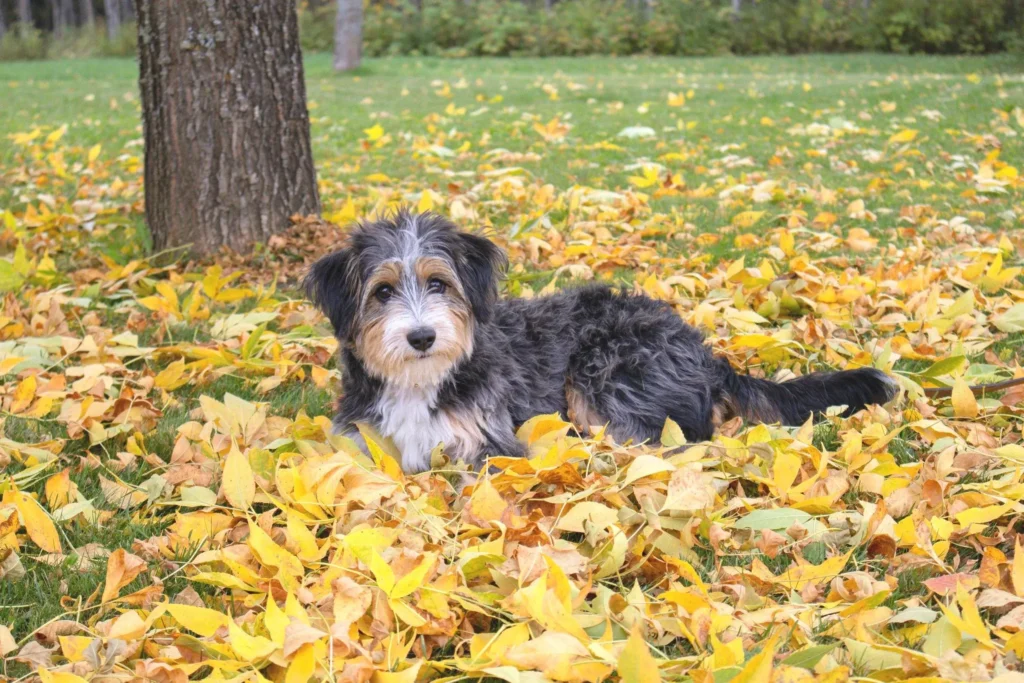
A genuinely active Mini Bernedoodle may need more calories during busy periods.
Increase food slowly when the dog begins losing weight and its health remains normal.
Do not make a large increase after one long weekend walk.
Look for a pattern over several weeks.
A dog recovering from an injury may need fewer calories.
Cold or rainy weather can also reduce outdoor movement. Some dogs gain weight during winter because their portions stay the same while exercise drops.
Reduce calories slightly when activity remains low for a long period.
Do not cut protein or balanced nutrition by replacing normal meals with vegetables. Feed a complete diet in the correct portion.
Many spayed or neutered dogs need fewer calories than intact dogs.
That does not mean every dog becomes overweight after surgery. Weight gain happens when calorie intake remains higher than calorie use.
Weigh the dog before the procedure and again during recovery. Adjust portions when its waist begins to disappear.
Treats can quietly add a large amount of food.
A dental chew may contain many calories. Cheese and peanut butter and table scraps count too.
The general veterinary guideline is to keep treats and snacks below 10 percent of daily calories. At least 90 percent should come from complete and balanced food.
A dog eating 600 calories per day should receive no more than about 60 calories from treats.
That amount disappears quickly when the owner uses large biscuits.
Set aside part of breakfast for training.
A Mini Bernedoodle usually cares about earning the food. It may not care that the reward came from its normal meal.
Use higher-value treats only for harder situations. Cut soft treats into very small pieces.
The dog rewards the taste and the action. It does not need a large chunk each time.
Peanut butter looks like a small snack. One spoon can contain many calories.
Cheese and meat pieces also add up. Family members may each think they gave only one treat. The dog may receive six or seven treats by the end of the day.
Use one treat container for the whole household. Place the daily allowance inside it each morning. When it becomes empty the dog has finished its extra calories for the day.
The food bowl cannot tell you whether the portion is correct. The dog’s body and energy and stool give you better information.
A 25-pound Mini Bernedoodle may be healthy.
Another dog at the same weight may carry too much fat because it has a smaller frame.
Use your hands as well as your eyes.
Feel the ribs. Look down at the waist. View the dog from the side and check for an abdominal tuck.
WSAVA describes an ideal dog as having ribs that are easy to feel with a light fat covering. The waist should be visible from above and the tummy should rise behind the ribs.
A growing puppy should be checked more often because body size changes quickly.
Keep a simple record of weight and daily food. Note major changes in treats and exercise.
Contact a veterinarian when appetite or weight changes suddenly.
Do not keep reducing food when a dog loses weight without a clear reason. Parasites and dental pain and digestive disease and other health problems can affect eating and body condition.
The best-looking ingredient list does not always tell you whether the full diet is balanced.
Start with the nutritional adequacy statement.
Choose a food that is complete and balanced for growth when feeding a puppy. Choose adult maintenance for a healthy adult.
Foods labeled for intermittent or supplemental feeding should not become the main daily diet. AAFCO notes that such products do not meet normal complete and balanced standards for continuous feeding.
Both dry and wet diets can provide complete nutrition when properly formulated.
Wet food contains more water. It may provide fewer calories in each cup or can because of its moisture.
Dry food is often easier to measure and use in training.
You can feed one type or combine them. Count calories from both.
Do not add a full wet-food portion on top of the normal dry-food amount. Replace part of the dry calories instead.
A homemade diet should be formulated by a veterinary nutrition specialist.
Meat with rice and vegetables may look healthy. It can still miss important minerals and vitamins.
Do not use random internet recipes for a growing puppy. Nutritional mistakes during growth can affect development.
How much should a Mini Bernedoodle eat each day? Start with its age and current weight. Check its food label for calories per cup or can.
A small adult may need close to 300 or 400 calories. A larger active Mini Bernedoodle may need 900 calories or more. Puppies need more calories for each pound because they are growing. They also need food made for the growth life stage. Feed young puppies in several small meals. Most healthy adults do well with two measured meals each day.
Keep treats below ten percent of total calories. Most important of all is body condition. You should feel the ribs under a light layer of fat and see a waist behind them.
No chart can replace watching the real dog. Measure the food. Check the body. Adjust the portion slowly. Ask your veterinarian for help when growth or weight or appetite does not look normal.