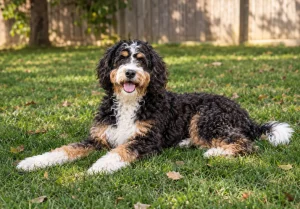
Mini Bernedoodles grow pretty fast during puppyhood. One month you have a tiny ball of fluff sleeping under your chair. A few months later that same puppy suddenly has long legs and takes up half the couch.
So when does all that growing actually stop?
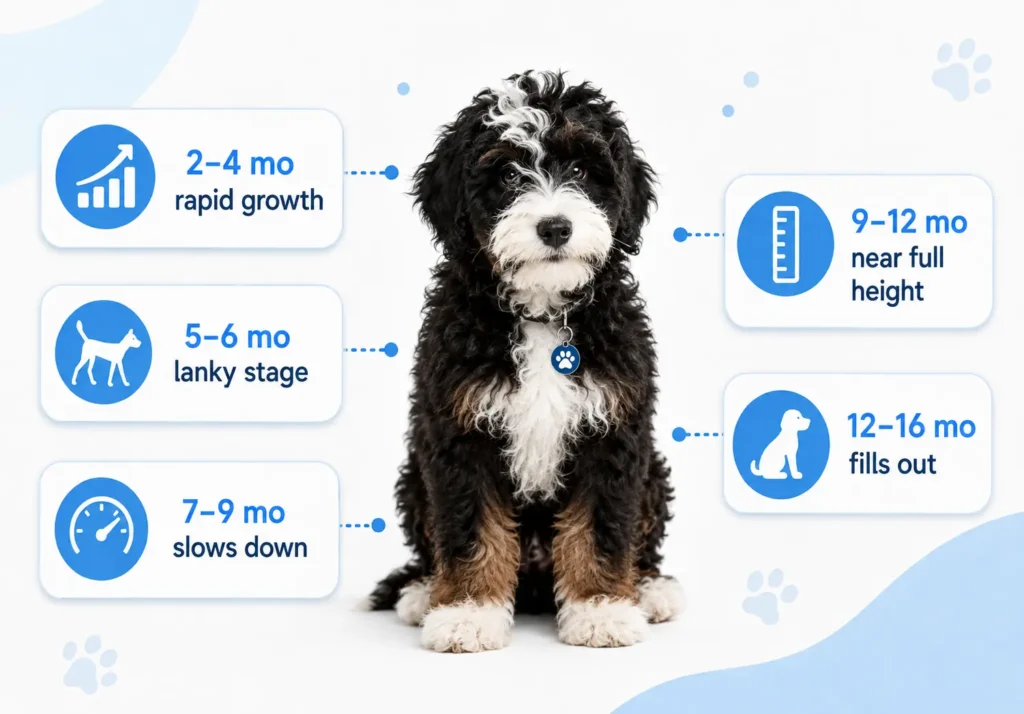
Most Mini Bernedoodles get close to their adult height around 9 to 12 months. Some keep filling out through 12 to 16 months. A bigger Mini Bernedoodle may take a little longer because growth speed is strongly connected to adult body size.
Don’t get hung up on one exact birthday though.
Mini Bernedoodles are mixed dogs. Their parents can be very different in size. A Bernese Mountain Dog is much larger than a Miniature Poodle. That gives puppies a fairly wide genetic range to work with. Even two puppies from one litter may finish at different weights.
Many adult Mini Bernedoodles fall somewhere around 25 to 45 pounds, with published estimates sometimes stretching closer to 50 pounds. Height is often around 18 to 22 inches at the shoulder, though smaller dogs do exist.
The number on the scale is useful. It isn’t the whole story.
Height, body shape, parent size, bone structure, nutrition, and the puppy’s growth pattern all tell you more.
| Age | What You May Notice | Growth Stage |
| 8 to 12 weeks | Small body and very fast changes | Early puppy growth |
| 3 to 4 months | Legs get longer and weight rises quickly | Rapid growth |
| 5 to 6 months | Puppy looks taller and less round | Strong growth period |
| 7 to 9 months | Height begins slowing in many minis | Adolescent stage |
| 9 to 12 months | Many reach close to adult height | Growth slowing |
| 12 to 16 months | Chest and body may keep filling out | Near adult size |
| 16 to 18+ months | Larger minis may still mature a little | Final body development |
This is only a rough guide. A puppy does not read a growth chart. Some grow early. Others seem to pause and then suddenly shoot up again.
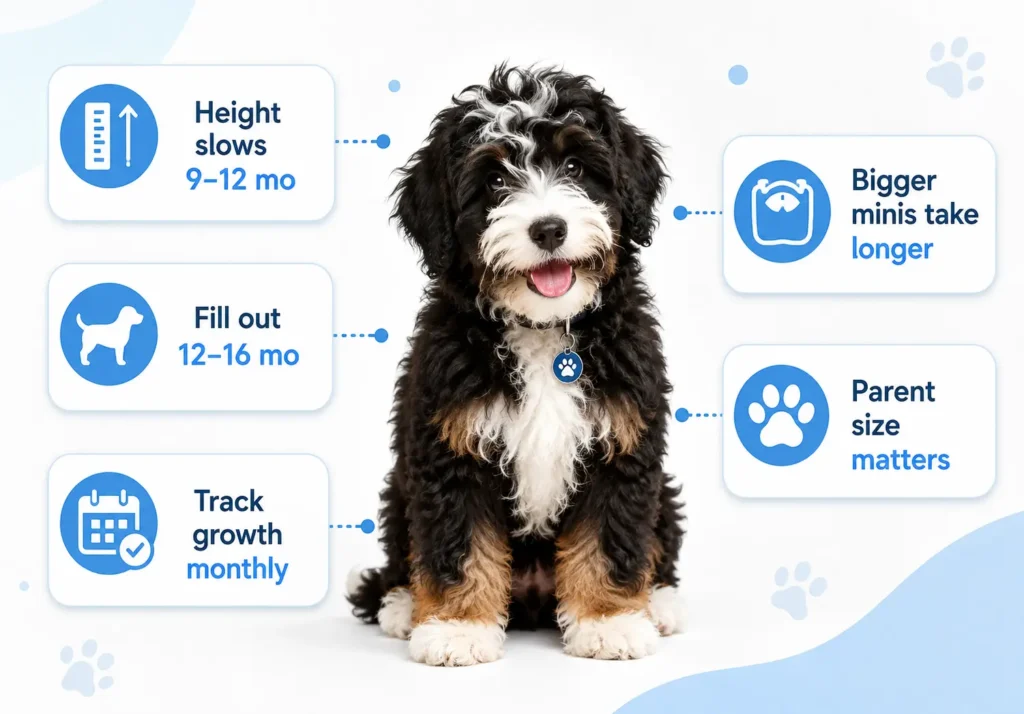
For many Mini Bernedoodles the fast part of growth slows near the first birthday.
Some may look almost adult by 9 or 10 months. Others keep gaining height or body mass for several more months.
That fits normal dog growth pretty well. Smaller dogs usually finish earlier. Medium dogs often reach mature body size around 9 to 12 months. Larger dogs can keep developing for 12 to 18 months or more.
Mini Bernedoodles can fall somewhere between those groups.
This throws people off sometimes.
Your puppy may stop getting noticeably taller but still gain several pounds.
That doesn’t always mean the dog is getting fat.
The chest can widen. Muscles develop. The neck gets thicker. That skinny teenage puppy starts looking more like an adult dog.
So there are really two things happening.
First comes most of the bone and height growth.
Then comes body maturity.
A dog at 11 months may be very close to final height but still look lean and unfinished.
Long bones contain areas called growth plates while a puppy is developing.
These areas create new bones. When the growth plates close, the bones stop getting longer. The timing changes with the expected adult size of the dog.
That’s one reason you shouldn’t expect every Mini Bernedoodle to stop growing on exactly the same day.
A 22-pound adult mini and a 48-pound adult mini can mature at different speeds.
The word mini can be a bit misleading.
Some Mini Bernedoodles are genuinely small.
Others are basically medium-sized dogs wearing a “mini” label.
If your puppy is heading toward the upper end of the Mini Bernedoodle range, don’t be surprised if the body keeps changing after 12 months.
A dog near 40 or 45 pounds may fill out longer than one that finishes around 20 or 25 pounds.
Growth is fastest early.
Puppies can seem to grow like weeds during those first several months.
Their paws look huge. Legs suddenly get long. The puppy that fit easily in your arms becomes awkward to carry.
That’s normal.
At this stage the puppy is still very young.
Size can vary a lot already.
One Mini Bernedoodle puppy may be quite small because it comes from smaller parent lines. Another can be much heavier even at the same age.
Don’t compare your puppy too closely with random photos online.
Look at its own pattern.
Steady growth matters more than matching another puppy pound for pound.
Now things start moving quickly.
Legs get longer. The body stretches. Appetite may seem huge because the puppy is using energy for growth and play.
This is also a good time to start tracking weight.
You don’t need to weigh the puppy every morning. That can be a bit pointless.
Every one to four weeks is usually enough to spot the general direction unless your veterinarian wants closer monitoring. Regular weight checks during the first 6 to 12 months can help track puppy growth.
Write the number down.
After a few months you’ll have your puppy’s own little growth curve.
The puppy may look lanky now.
Those soft round baby proportions begin disappearing.
The legs can seem too long for the rest of the body. Some Mini Bernedoodles look almost like they were built from spare parts for a couple of months.
That awkward stage passes.
Rapid growth in dogs often starts slowing after about six months, though development continues after that.
Growth is still happening but may not look as dramatic.
Your dog may gain weight without changing much in height.
The head and chest also start looking more mature.
This is adolescence too. Physically the dog is getting bigger while mentally it may still behave very much like a goofy puppy.
Don’t let the adult-sized body fool you.
Training still needs work.
A lot of Mini Bernedoodles are close to adult height during this window.
Published Mini Bernedoodle growth estimates commonly place the slowing or stopping point around the first year, though some continue filling out afterward.
You may notice that the height barely changes from month to month.
Weight can still creep upward.
Now the changes are usually smaller.
The dog may gain muscle and look broader through the chest.
A skinny adolescent body starts looking more balanced.
Larger minis may keep developing a little longer.
By this point you should have a pretty good idea of the dog’s adult size.
Height is measured from the floor to the top of the shoulders.
Not the head.
Not the tips of the fluffy ears.
Put the dog on a flat floor and measure to the highest point of the shoulder blades.
Many published Mini Bernedoodle guides place adult height around 18 to 22 inches. Some breeding lines labeled mini are smaller and may fall closer to the mid-teens.
That range is wide for a reason.
Parent height is one of your best clues.
The two parent breeds can be dramatically different.
Adult Bernese Mountain Dogs commonly stand roughly 23 to 27.5 inches at the shoulder depending on sex. Miniature Poodles are much smaller at around 10 to 15 inches. Mix those genetics together and there’s room for surprise. This is especially true with first-generation crosses.
You may see labels such as F1 or F1B.
An F1 Mini Bernedoodle normally comes from a Bernese Mountain Dog and a smaller Poodle.
An F1B often has more Poodle influence because a Bernedoodle is crossed back to a Poodle.
That does not guarantee one exact adult height. Still, knowing the exact parents and their adult sizes is much more useful than simply hearing the word mini.
You don’t need weekly height checks.
Every two or three months is plenty.
Use the same floor and measuring method each time.
You may see fast early jumps and then almost nothing after 10 or 11 months.
That slowing is a pretty good sign that adult height is getting close.
This is the number everybody wants.
“How many pounds will my puppy be?”
Fair question.
Unfortunately there isn’t one magic answer.
Published adult Mini Bernedoodle estimates commonly sit around 25 to 45 pounds, while some sources use a wider range that reaches roughly 50 pounds. Other smaller lines can finish closer to 20 pounds.
So think range, not exact number.
The parent breeds are miles apart in body size.
Adult Bernese Mountain Dogs can weigh around 70 to 115 pounds depending on sex. Miniature Poodles are commonly around 10 to 15 pounds.
That’s a huge gap.
A breeder may use a particularly small Bernese line or a larger Poodle. Another pairing may be completely different.
This is why two dogs, both called Mini Bernedoodles, may look nothing alike on the scale.
You may hear things like:
“Double the puppy’s 16-week weight.”
That trick can give a rough idea for some dogs. It isn’t a promise.
General puppy size calculators often use formulas based on age and expected breed size. They work better as ballpark estimates than exact predictions. Mixed dogs are especially tricky.
Your puppy might hit a late growth spurt.
Another may do almost all its growing early.
Use the formula for fun if you want. Just don’t order an expensive custom-sized dog door based on it.
Say your dog was predicted to become 35 pounds.
It reaches 31 pounds and stops growing.
That doesn’t mean something went wrong.
If the dog has a healthy body condition and normal development, 31 pounds may simply be its natural adult size.
The scale is important but it’s not the only thing.
You should be able to feel the ribs without digging through a thick layer of fat.
Look for a waist when viewing the dog from above.
A fluffy coat can hide body shape, so use your hands too.
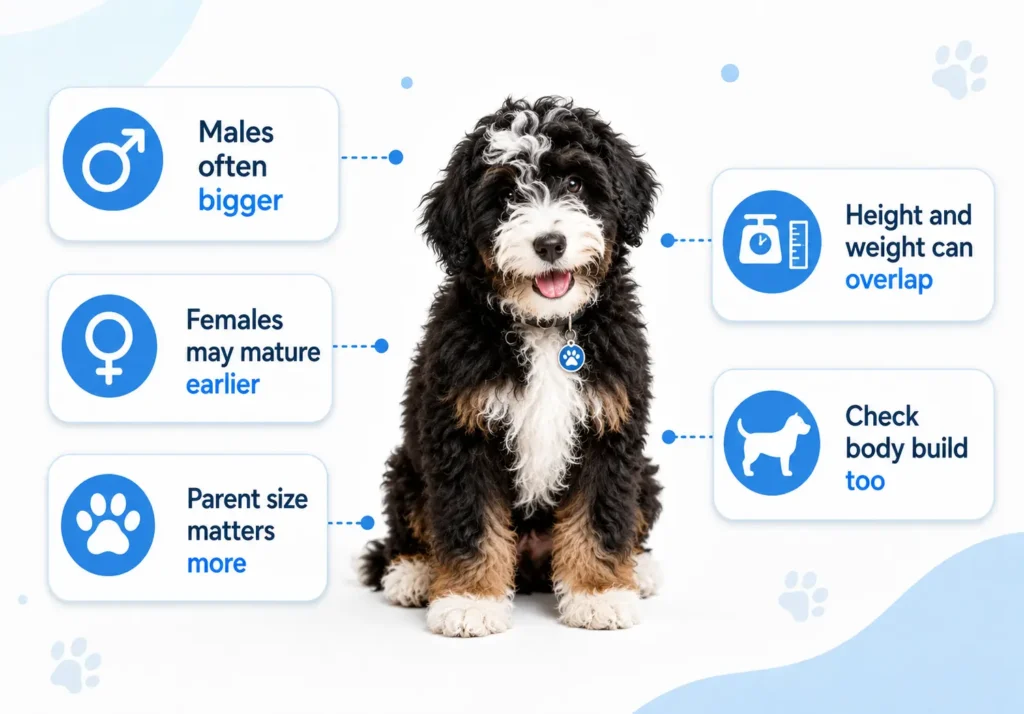
Male Mini Bernedoodles may sometimes finish larger than females.
But don’t treat that as a rule carved in stone.
Parent genetics can easily matter more.
A female from larger parents may outweigh a male from smaller parents.
The Bernese Mountain Dog parent breed does show a clear size difference between adult males and females. Males are generally taller and heavier. Still, your Mini Bernedoodle receives genes from both sides.
Poodle size matters.
Generation matters.
The exact parents matter.
Even littermates receive slightly different genetic combinations.
So knowing the puppy is male gives you one clue.
Seeing that its mother weighs 65 pounds and its father weighs 14 pounds gives you much more useful information.
Two dogs can weigh 30 pounds and look completely different.
One may have a fine Poodle-like frame. Another might be stockier with a wider chest and heavier bone. That’s why photos and scale numbers alone can throw you off. Look at the whole dog.
Height.
Weight.
Chest.
Leg length.
Body condition.
It all matters.
Genetics lead the show.
Food and health still matter though.
You cannot feed a genetically 25-pound dog into becoming a healthy 45-pound dog.
And you shouldn’t try.
Adult body size has a strong genetic set point. Controlled steady puppy growth supports healthy body condition rather than forcing maximum growth speed.
This is the big one.
Ask how much both parents weigh.
Ask their shoulder height too.
If previous litters from the same parents exist, adult sizes from those dogs can be very helpful.
That real family information is better than a generic online calculator.
An F1 puppy can inherit a broad mix of traits from both sides.
Backcross generations may lean more heavily toward one parent line.
None of this creates a perfect size guarantee.
Genes don’t divide themselves into neat little boxes just because a puppy has a label.
Growing puppies need enough energy and nutrients.
More is not always better.
Overfeeding does not safely turn the puppy into a bigger adult. It can make growth too fast and place extra stress on developing bones and joints, especially in dogs heading toward larger adult sizes.
Feed a complete puppy diet suited to the dog’s expected adult size.
Measure portions. Adjust as the body changes. If the puppy starts looking heavy, don’t wait six months to fix it.
Health problems can slow growth.
Heavy intestinal worm infections can steal nutrients and calories from a young puppy. Severe cases may affect normal growth.
Watch for diarrhea.
A swollen belly.
Poor coat.
Low energy.
Slow weight gain.
Those signs deserve a vet check.
Don’t just keep adding more food.
Sometimes the problem isn’t the amount in the bowl.
Puppies need exercise.
They also need a bit of common sense.
Normal running, walking, sniffing, and play build strength and coordination.
Repeated hard impact while bones are still developing is another thing. Don’t turn a six-month-old puppy into your long-distance running partner. Growth plates are still developing during puppyhood and larger dogs may take longer to reach full skeletal maturity.
Puppies sleep a lot.
Let them.
A growing dog doesn’t need activity every waking second.
Good sleep supports normal development and also saves you from dealing with an overtired little monster running through the house at 10 p.m.
You probably won’t wake up one morning and think:
“Yep. Growth finished at exactly 8:14 a.m.”
It happens slowly.
The easiest way to tell is to track the dog over several months.
Measure your dog at the shoulder.
Then measure again six or eight weeks later.
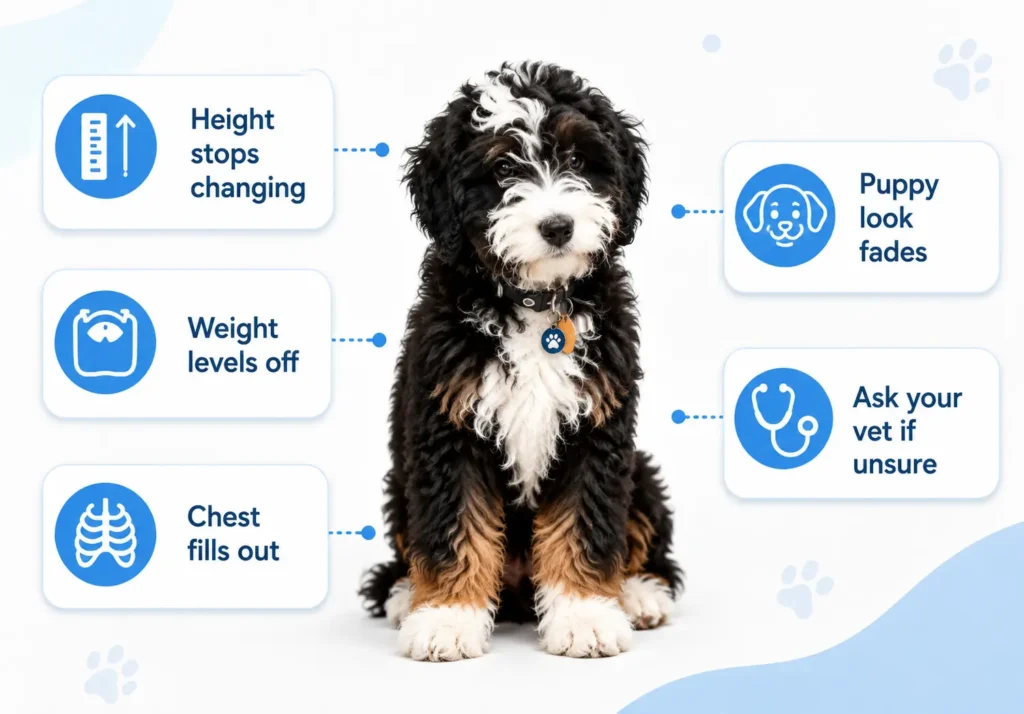
If the height stays almost identical across several checks, vertical growth is probably close to done.
The body can still fill out afterward.
Adult weight does not stay exactly the same every day.
Water.
Food.
Poop.
Activity.
All of those can move the scale slightly.
Look for the bigger pattern.
If your dog stays around the same healthy weight for several months and height has also stopped changing, it is probably close to full size.
Young puppies have a softer look.
The head seems round.
The body is less defined.
During adolescence the legs can look ridiculously long.
Then things settle down.
The chest broadens.
Muscle develops.
The head and body start looking more balanced.
That adult shape is another clue.
If you really need to know whether skeletal growth has finished, a veterinarian can give you better guidance based on the individual dog.
This becomes especially useful before starting high-impact sports or heavy running.
In some situations imaging can show whether certain growth plates have closed, though most normal family dogs do not need X-rays simply to answer a growth question.
You don’t need to become obsessed with the scale. During the first few months, weighing every two to four weeks gives you useful information. After six months you can spread the checks out.
Try this simple routine:
A chart is useful when it helps you notice a pattern.
It becomes less useful when you start worrying because your puppy is two pounds different from somebody else’s dog on the internet.
Slow growth isn’t always a problem.
Some dogs are just small.
Still, keep an eye on the full picture.
Talk with a veterinarian if your puppy has poor weight gain along with diarrhea, frequent vomiting, a swollen belly, low energy, poor appetite, dull coat, repeated limping, or unusual leg shape.
Rapid weight gain deserves attention too. Extra body fat can be hard to see under a Bernedoodle coat.
Run your hands over the ribs and waist. A puppy should grow steadily, not simply get rounder every month.
This sounds obvious.
People still do it all the time.
A Standard Bernedoodle may have a Standard Poodle parent and can become much larger.
Mini Bernedoodles are usually produced using smaller Poodle lines, which brings expected adult size down.
Bernedoodles as a whole have a very wide size range because different Poodle sizes can be used. Published profiles commonly divide them into tiny, miniature, and standard groups rather than one uniform size.
Make sure the growth chart you’re looking at is actually for a mini.
Otherwise the numbers can look terrifying.
Big paws are a clue.
They are not a measuring tool.
A puppy with oversized paws may still have plenty of growth left.
But fur can make paws look huge. Some dogs simply have broader feet.
Look at parent size and the puppy’s actual growth curve instead.
Those give you better information.
The same goes for head size.
A chunky-looking puppy isn’t automatically going to become a huge adult.
Possibly.
A dog may stop getting taller but continue adding muscle and filling out.
That can happen through the second year in larger individuals.
The important part is body condition.
A 13-month-old dog gaining two pounds of healthy muscle is different from one gaining ten pounds of body fat.
Feel the ribs.
Look at the waist.
Watch how easily the dog moves.
If you’re not sure, ask at the next vet visit.
Don’t switch only because the puppy had its first birthday.
Food needs depend partly on expected adult size and maturity.
Small and medium dogs often mature earlier than large dogs. Guidance for puppy feeding commonly places small and medium dogs near physical maturity around 10 to 12 months, while larger dogs can take longer.
A smaller Mini Bernedoodle may be ready earlier than a large one.
Ask your veterinarian when the switch makes sense for your dog.
The goal isn’t to keep feeding puppy food forever.
It also isn’t to rush a still-growing puppy onto an adult plan.
Most Mini Bernedoodles get close to their adult height around the first year. Many finish most obvious growth between about 9 and 12 months, while some keep filling out until 12 to 16 months or a little longer.
Adult size can vary a lot.
Many Mini Bernedoodles land somewhere around 25 to 45 pounds and roughly 18 to 22 inches tall, but smaller and larger dogs exist. There is no single official Mini Bernedoodle size standard.
Don’t chase one perfect number.
Look at the parents. Track your puppy’s own weight and height. Keep the body lean and feed for steady growth.
And yeah, expect a few surprises.
These little guys can grow like weeds for months and then suddenly slow down. Another puppy may look finished and squeeze in one last growth spurt.
The best sign is the overall pattern.
When height stays steady, healthy weight levels off, and that lanky puppy body starts looking balanced and adult, your Mini Bernedoodle is probably pretty close to being fully grown.