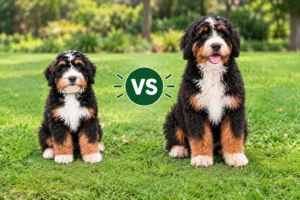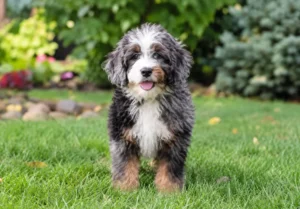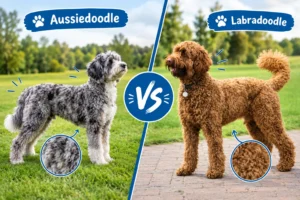

Mini Aussiedoodles can make really good family dogs. They’re smart, playful, loving, and usually want to be involved in whatever their people are doing.
But here’s the part people sometimes skip. These little guys are not lazy teddy bears.
A Mini Aussiedoodle usually comes from an Australian Shepherd and a smaller Poodle line. Both sides can bring a lot of brain power and energy. That can be great in a busy family. It can also become a handful if nobody has time for walks, play, training, and grooming.
Their personality isn’t perfectly predictable either. One puppy may be calm and cuddly. Another may be much more active and want to chase everything that moves. Coat type can change too. So can shedding and grooming needs.
Most well-socialized Aussiedoodles are described as friendly and loving dogs that can live successfully with children and other pets. Their Australian Shepherd side may also bring herding behavior such as chasing or nipping at moving feet.
So yes, Mini Aussiedoodles can fit beautifully into family life. You just need to know what you’re signing up for.
| Family Question | What to Expect |
| Good with children? | Often yes with training and supervision |
| Good with other dogs? | Usually when socialized properly |
| Good with cats? | Can be, though some may chase |
| Easy to train? | Usually very trainable and quick to learn |
| Energy level | Moderate to high in many dogs |
| Shedding | Often lower than many breeds but it varies |
| Grooming | Regular brushing and coat care needed |
| Likes being alone? | Many prefer staying close to their people |
| Apartment friendly? | Possible if exercise needs are met |
| Good first family dog? | Can be for an active and prepared family |
A Mini Aussiedoodle often wants to be right in the middle of family life.
Someone is making breakfast? The dog is probably nearby.
Kids are playing in another room? It wants to know what’s going on.
You sit down after a long day and suddenly there’s a curly little face staring at you.
That people-focused nature is a big reason families like Aussiedoodles. They’re commonly described as affectionate, loyal, playful, and highly social dogs.
Mini Aussiedoodles may form strong bonds with one person or the whole family.
That’s nice. Really nice.
The downside is that an extremely attached dog may struggle if nobody teaches it how to relax alone.
A puppy shouldn’t need a human sitting beside it every second of the day. Give it safe little breaks from you from the beginning.
Let the puppy rest in its bed while you move around the house. Give it a safe chew or food puzzle and allow it to settle.
Small bits of independence early on can make everyday life much easier later.
These dogs often enjoy activity happening around them.
They may learn family routines surprisingly fast. Breakfast happens at 7? They know. School pickup happens in the afternoon? They may start waiting near the door.
Their intelligence is one of their best traits. It also means boredom can hit them pretty hard.
A bored dog may invent its own entertainment.
That can mean stealing socks, barking at the window, digging around the yard, or turning a paper towel into 200 tiny pieces.
Mental work matters almost as much as physical exercise for this mix. Aussiedoodles are commonly described as dogs that need both daily movement and mental enrichment.
Don’t get too hung up on one description online.
This is a mixed dog.
One puppy might take more after the Poodle side. Another may show stronger Australian Shepherd traits.
The second puppy could be more watchful, energetic, or interested in herding movement.
Meet the puppy when possible. Look at the parents too. Temperament in the family line can tell you more than coat color ever will.
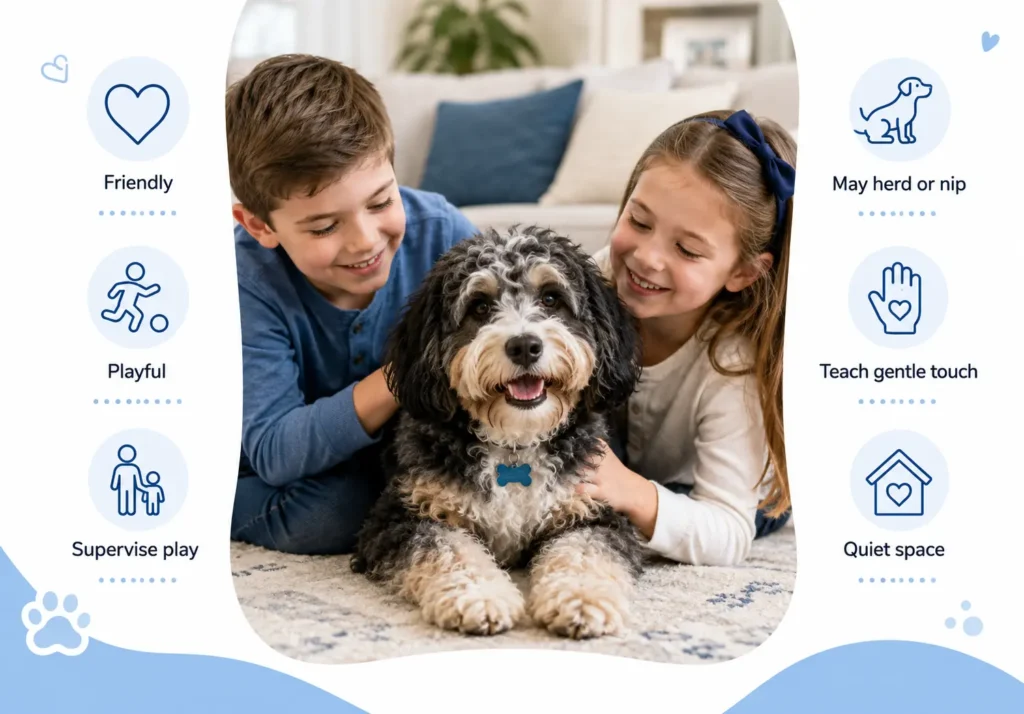
Usually, they can be.
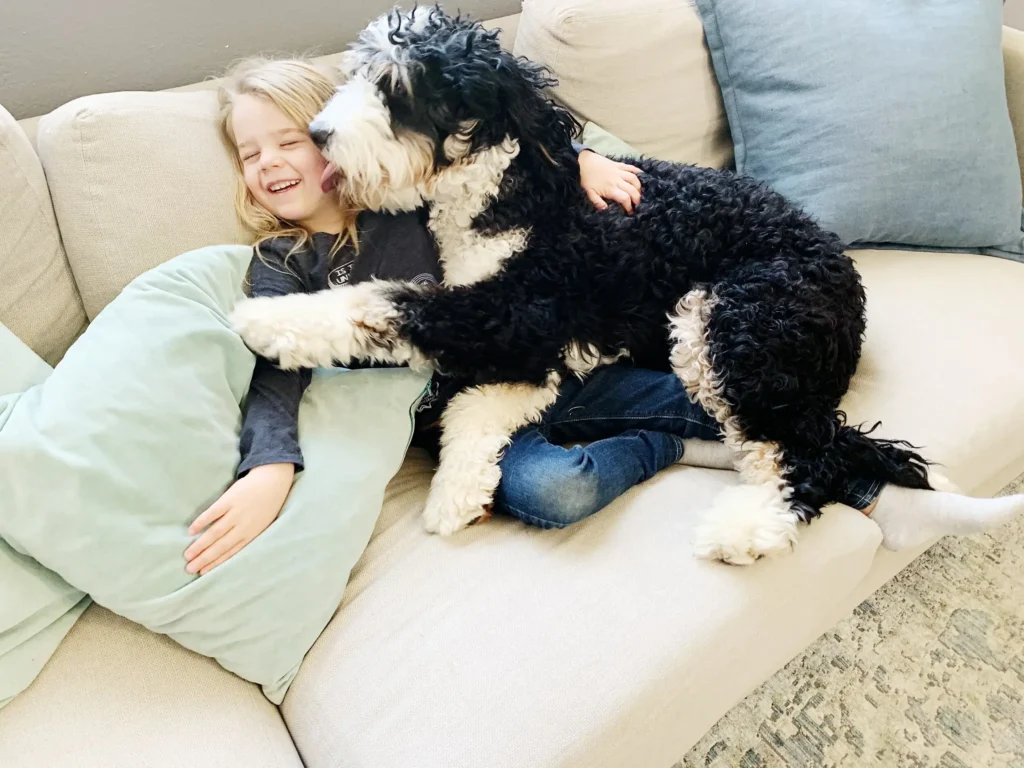
A friendly Mini Aussiedoodle may love playing with children. The dog has energy and the kids have energy. Sometimes it’s a pretty good match.
Well-socialized Aussiedoodles are often reported to do well with children, especially when families put time into training and boundaries. There is one thing you really need to watch though.
Australian Shepherds were developed to control moving livestock. A Mini Aussiedoodle may inherit a little of that instinct.
A child runs across the yard and the dog thinks this is very exciting. It follows. Then it circles. Then maybe it nips at the child’s pants or heels.
That doesn’t automatically mean the dog is aggressive. It may simply be trying to control movement in the way its herding genes tell it to. Aussiedoodles can show behaviors such as circling children or nipping at moving heels because of the Australian Shepherd side. Early training can help manage it.
Still, teeth are teeth. Even playful nipping can scare a child.
Give the dog something better to do.
A ball works.
A tug toy works.
A simple “come” or “leave it” exercise can work too once the dog understands it.
Don’t let chasing children become the dog’s favorite daily game. The more often a puppy practices a behavior, the better it gets at that behavior. That includes the annoying stuff.
Dog training only solves half the problem. Kids also need to know how to behave around a dog.
A useful family rule list looks like this:
Very young children and dogs need active adult supervision.
That goes for friendly dogs too.
A good family dog can still become uncomfortable if a toddler falls on it or grabs a handful of fur.
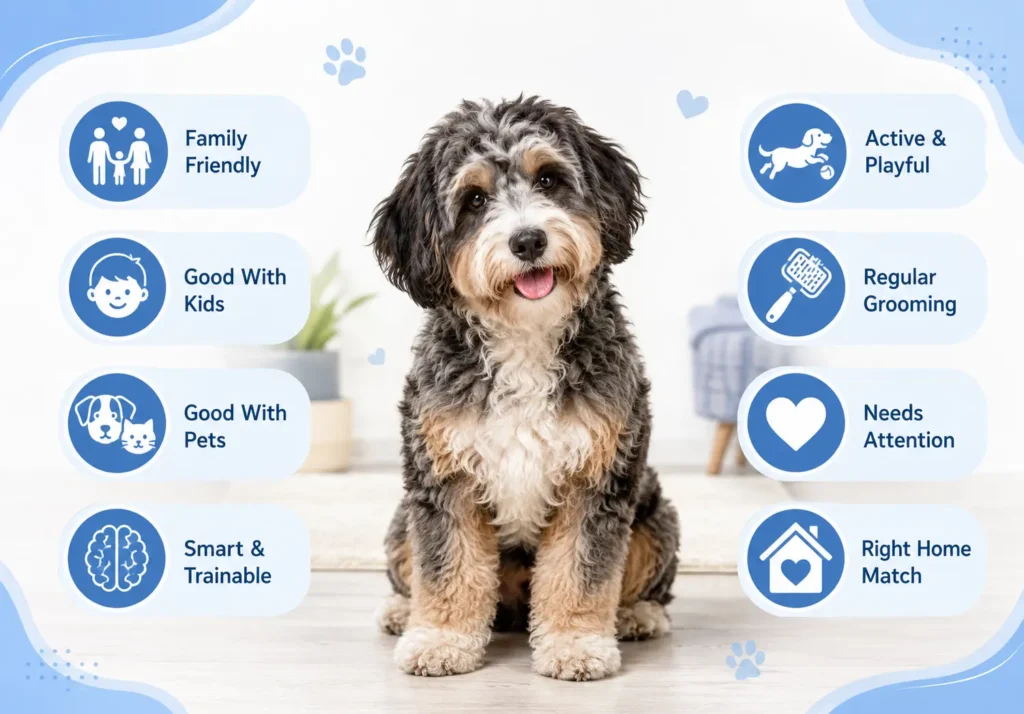
Many do.
Early socialization makes a big difference.
A Mini Aussiedoodle puppy that grows up around another calm dog may see that animal as part of normal daily life.
Cats can work too.
The tricky part is movement.
A cat running across the room can wake up a dog’s chase instinct pretty fast.
Aussiedoodles are generally considered capable of living well with other pets when socialized properly, though some may inherit stronger chasing or herding behavior.
Don’t put the new puppy and your older cat nose-to-nose on day one and hope they work it out.
If the puppy starts staring hard, pulling, whining, or trying to chase, increase the distance.
Two dogs may play together and keep each other busy.
Sounds perfect, right?
Well, mostly.
Another dog doesn’t replace your training or exercise work. Two bored dogs can create twice as much nonsense. Also feed them separately at first. This lowers the chance of food competition. Give each dog its own bed and chews. They don’t need to share everything just because they live together.
Rabbits, birds, guinea pigs, and other small animals need much more care around dogs. A Mini Aussiedoodle may be gentle. It may also become extremely interesting when a tiny animal runs.
Use secure housing. Don’t rely only on training when a big size difference could make one mistake dangerous.
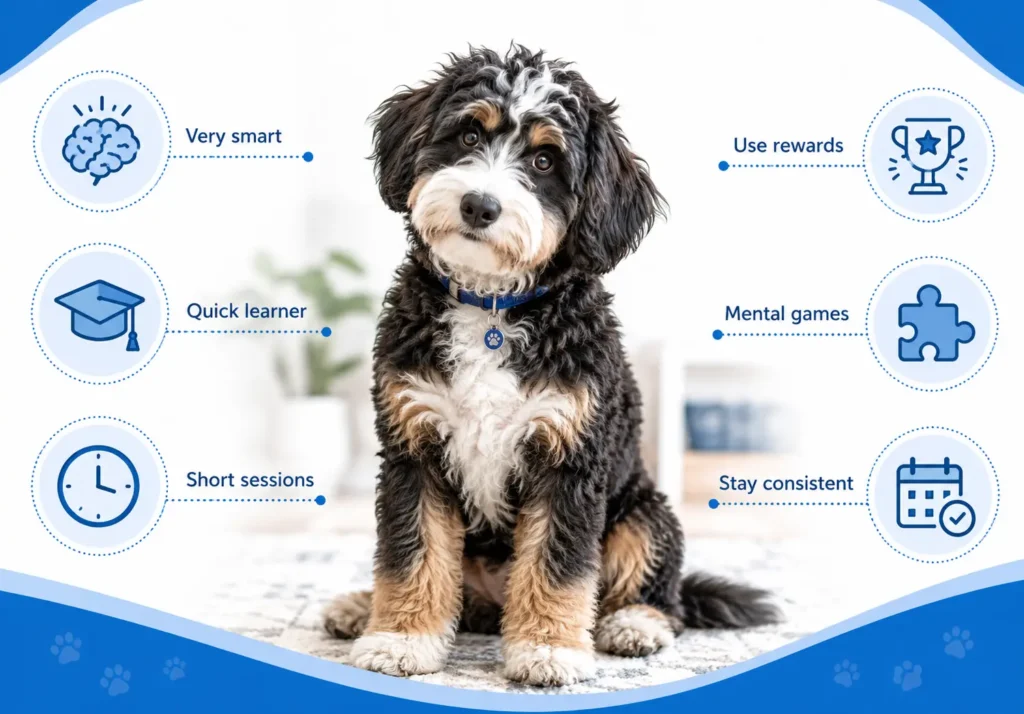
Training is one area where Mini Aussiedoodles can really shine. Both sides of the mix are known for being clever.
That means they may learn “sit” in no time. It also means they may learn how to open a half-closed door or steal food when nobody is looking. Smart doesn’t always mean easy.
Don’t wait for bad habits to show up.
Start with simple things.
Teach the puppy its name.
Practice comes, sit, wait, leave it, and walk without dragging you down the street. House training should start right away too. Take a puppy outside after waking, eating, drinking, playing, and sleeping. Reward the right behavior the moment it happens.
Positive and consistent training is commonly recommended for Aussiedoodles because their intelligence and desire to engage with people can make them quick learners.
A 30-minute training session can become boring.
Five minutes can be plenty.
Teach one or two things. Stop while the dog is still interested.
Come back later.
Several little sessions during the day often fit family life better anyway. You can practice “wait” before opening the door. Ask for “sit” before dinner. Practice “come” across the living room. Training doesn’t always need to look like school.
A smart dog without a job often finds one.
Unfortunately, its chosen job may be “professional couch destroyer.” Use food puzzles. Hide treats around one room and let the dog sniff them out.
Teach toy names.
Practice simple tricks.
Even ten minutes of focused brain work can take the edge off a busy dog. This mix often benefits from mental stimulation in addition to walks and physical exercise.
Mini Aussiedoodles are small enough that people sometimes assume they don’t need much exercise.
Don’t let that fool you.
They can be pretty energetic.
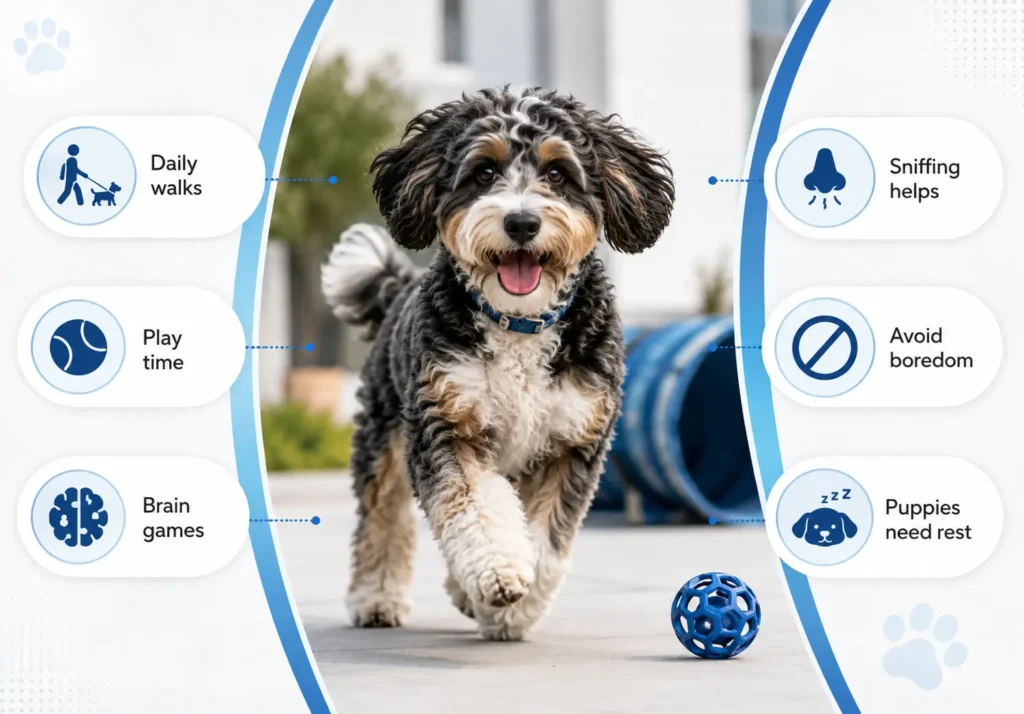
The Australian Shepherd side brings working-dog energy. Poodles are active dogs too. The exact amount varies by age, health, size, and individual temperament. Some Mini Aussiedoodles are busy little rockets. Others settle more easily after a decent walk.
Aussiedoodles are generally described as active dogs that do best when families provide regular physical activity and mental work.
You don’t need to turn every day into a marathon.
Later you might add a food puzzle or another short walk. Sniffing is important. Don’t rush every walk. A dog standing beside one bush for 40 seconds may look like it’s doing nothing. Its nose is taking in a whole pile of information.
That’s brain exercise.
Puppies have energy but their bodies are still growing. Short play periods work better than forced long-distance exercise.
Let them rest.
Seriously, puppies sleep a lot. An overtired puppy may become wild instead of sleepy. You may see jumping, biting, barking, and zooming around the room like its batteries were installed backward. Sometimes the answer isn’t another walk.
It’s a nap.
A fenced yard is useful.
It makes bathroom breaks and quick play sessions easy. But a yard doesn’t exercise a dog by itself. Plenty of dogs stand in a yard for ten minutes and then sit by the back door waiting for their human.
An active family in a smaller home may suit an Aussiedoodle better than a large home where nobody walks or trains the dog.
This is where people can get caught off guard. Mini Aussiedoodles may shed less than many other dogs. That does not mean their coat is maintenance-free. In fact, a low-shedding curly coat can take more work because loose hair becomes trapped instead of falling onto the floor.
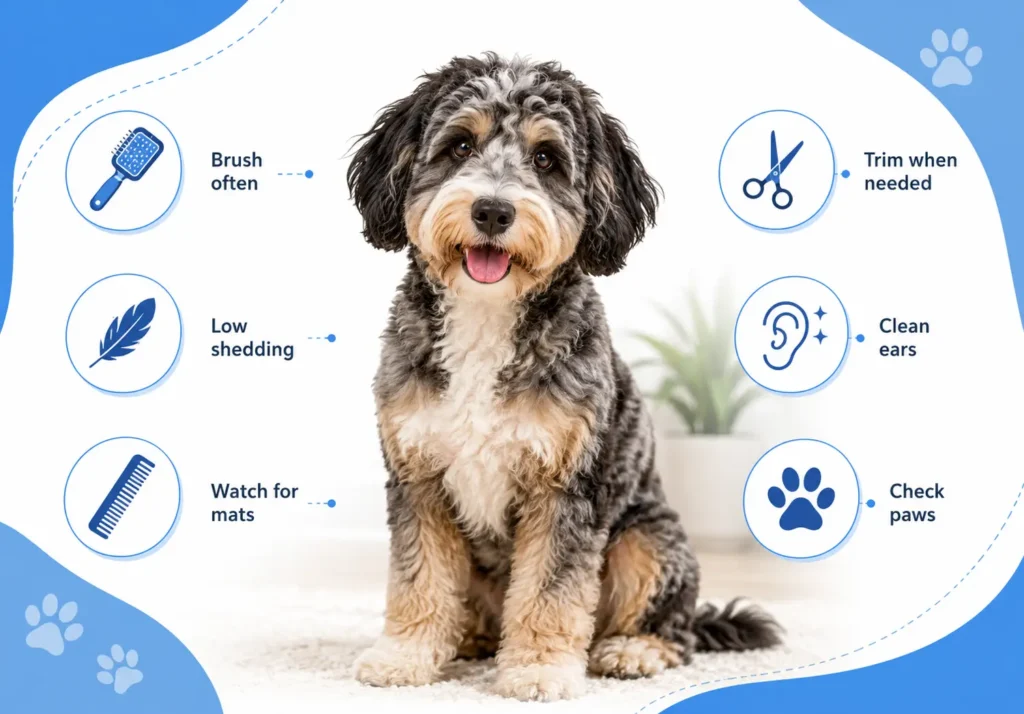
Aussiedoodle coats can range from straighter to wavy or curly, and regular brushing is important because tangles and mats can build close to the skin.
A looser wavy coat may be easier to brush. A thick curly coat can mat quickly. The areas behind the ears are trouble spots. So are the armpits, chest, legs, collar area, and tail. Run your fingers through those spots. If your fingers stop halfway through the coat, the brush probably isn’t reaching the skin either.
Brushing only the fluffy top layer looks nice.
It can still leave a solid mat underneath.
Work in small sections.
Part the hair and brush from near the skin toward the ends.
Be gentle.
If a mat is tight against the skin, don’t yank at it for twenty minutes. That hurts.
A groomer may need to clip severe mats safely.
Stop.
Do it again tomorrow.
This stuff seems almost too simple, but it pays off later.
A grown dog with a long coat will need regular grooming. Teaching it to stand calmly while someone handles its feet and face can save a lot of stress.
No dog is guaranteed to be completely hypoallergenic.
Some Mini Aussiedoodles shed less and may spread less loose hair around the house. That doesn’t mean every person with dog allergies will be fine around one.
Allergens can come from skin flakes and saliva too.
The amount of shedding can also vary from one Aussiedoodle to another because coat inheritance isn’t identical in every puppy. If allergies matter a lot in your family, spend real time around similar adult dogs before bringing a puppy home.
Mini Aussiedoodles often like being close to people.
That’s part of their charm.
It can also become a problem when a dog never learns how to handle alone time. Some Aussiedoodles may develop separation-related distress. Reported signs include whining, pacing, barking, destructive behavior, and attempts to escape when left alone.
Don’t spend every second with a new puppy for three weeks and then suddenly leave it alone for eight hours.
The goal is pretty boring. You want the puppy to learn that people leave and then come back. No drama.
A dog waiting by the door is not automatically suffering from separation anxiety.
Look for stronger signs.
These may include nonstop barking, heavy drooling, scratching at doors, destroying escape points, bathroom accidents despite being house trained, or being unable to settle.
A camera can help you see what happens while nobody is home. Serious panic needs more than simply giving the dog a toy. Talk with a veterinarian or a qualified behavior professional when the problem is strong.
Family dogs need attention. They also need the ability to switch off.
Teach calm time.
Let the dog lie on a bed while people watch TV. Not every waking minute needs fetch, petting, training, or food. A dog that learns to relax around everyday family noise is much easier to live with.
This is the big question.
The answer depends more on your family than the dog.
A Mini Aussiedoodle can be a pretty wonderful match for a family that enjoys activity and wants a dog involved in everyday life. Multiple breed guides describe Aussiedoodles as strong family companions when households can meet their training, social, exercise, and grooming needs.
But they are not right for everybody.
Your family enjoys walks and outdoor time. Someone has time for training.
You don’t mind brushing.
You want a dog that likes people and tends to stay involved in family life. You’re willing to teach children how to behave safely around a dog. You can provide mental games as well as exercise. You can deal with possible herding behavior instead of becoming angry when the puppy chases feet.
That’s a pretty good starting point.
A Mini Aussiedoodle may be harder to manage if everyone leaves early and comes home late.
The dog can’t groom itself.
It can’t train itself.
And no, buying another dog doesn’t automatically solve loneliness or boredom. If you want a dog that is happy doing almost nothing most days, this mix may not be the best fit.
Breed mix gives clues. It doesn’t tell the whole story. Watch how the puppy reacts to people.
Does it recover after a new sound?
Does it explore?
Is it wildly pushy with other puppies or very nervous?
Ask about the parents’ behavior. A responsible seller or rescue should be able to tell you something useful about the dog instead of only saying “great family puppy.”
Mini Aussiedoodles often do better when life has some kind of rhythm. It doesn’t need to run like a military schedule.
Something like this can work:
Some dogs need more activity. Some need less.
Age changes everything too. A young adult may want more action than a senior dog. A puppy may look energetic but still need loads of sleep. Watch the dog in front of you.
The first one is grooming. That fluffy coat can turn into mats pretty fast if brushing gets skipped.
Second is mental energy.
A walk may tire the legs but not always the brain.
Third is consistency.
If one person allows jumping and another person gets angry about it, the dog gets mixed messages. And then there’s adolescence. That sweet puppy may suddenly seem to forget half its training as it grows up.
It happens.
Keep practicing. Don’t assume the dog has become “bad.”
Are Mini Aussiedoodles good family dogs? For many homes, yes.
They can be affectionate, clever, playful, and very connected to their people. They often do well with children and other pets when socialization starts early and adults set clear rules.
Still, they need work.
Their active brain needs training. Their body needs exercise. That fluffy coat needs real brushing, not one quick swipe across the top every few weeks.
Some Mini Aussiedoodles may herd running children. Others can struggle with being left alone. Coat type and energy level can also vary more than people expect.
Don’t let that put you off if your family is ready for the job.
A home that offers attention, safe play, steady training, grooming, rest, and plenty of everyday involvement can be a pretty great place for one of these little guys.
The main thing is matching the dog to your real life, not the life you imagine you’ll have after getting a puppy.