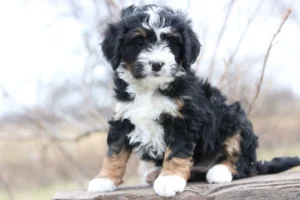

Many Mini Bernedoodles are good with kids. They are often loving and playful dogs that enjoy being part of family life. Some become gentle playmates for older children. Others enjoy resting near the family while everyone watches television or does homework.
Still no dog is automatically safe with every child.
A Mini Bernedoodle comes from a Bernese Mountain Dog and a Miniature Poodle. Bernese Mountain Dogs often have a sweet and affectionate nature. They also have a reputation for being gentle around children. Miniature Poodles are active and very smart dogs that usually respond well to training. A Mini Bernedoodle may inherit a different mix of these traits from each parent.
The dog’s early experiences matter too. A puppy that meets calm and respectful children may learn that kids are safe. A puppy that gets chased or grabbed may begin to fear them.
Children must also learn dog manners. They should not pull fur or climb on the dog. They should leave the dog alone while it eats or sleeps.
The safest goal is not to make the dog tolerate everything. The goal is to build trust between the dog and child.
| Situation | Positive Sign | Warning Sign | Best Adult Response |
| Child enters the room | Dog stays loose and relaxed | Dog freezes or hides | Increase space |
| Gentle petting | Dog stays nearby by choice | Dog turns its head away | Stop the interaction |
| Active play | Dog takes natural breaks | Dog jumps and mouths hard | Pause the game |
| Food time | Dog eats calmly alone | Dog stiffens near the bowl | Keep children away |
| Rest time | Dog sleeps without being disturbed | Child follows the dog | Use a dog-only area |
| New visitor | Dog watches and settles | Dog barks or growls nonstop | Use a gate and slow introduction |
| Toy play | Dog releases the toy calmly | Dog guards or snaps | Remove shared toys safely |
| Walking together | Dog stays under adult control | Child gets pulled over | Adult holds the leash |
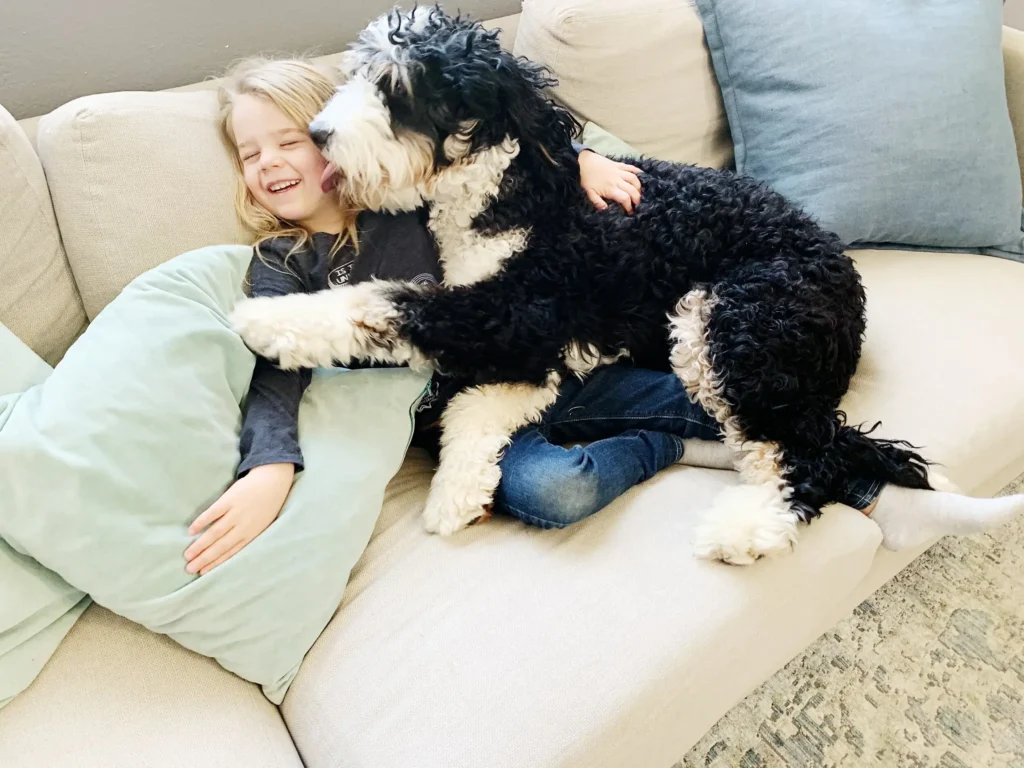
A Mini Bernedoodle’s temperament around children may be friendly and affectionate. Many enjoy attention and want to join family activities.
The Bernese Mountain Dog side may add a calm and devoted nature. The Poodle side may add energy and quick learning. This combination can work well in an active family that provides training and daily exercise.
A friendly dog can still become tired or scared.
Young children often move fast. They may scream or drop toys or run through the home. A sensitive Mini Bernedoodle may feel overwhelmed by this activity.
The dog may walk away or lick its lips. It may yawn even though it is not sleepy. It may turn its head or lower its body.
These quiet signals matter.
A dog should not need to growl before adults give it space. Stress signs can include tucked ears or tail and lip licking and yawning and showing the whites of the eyes. Learning these signals helps adults stop an interaction before the dog feels trapped.
Mini Bernedoodle puppies often jump and mouth during play.
They may chase running feet or grab loose clothing. This is usually puppy behavior rather than aggression. Still it can frighten or hurt a small child.
A puppy and toddler should not play together without an adult close enough to step in at once.
Give the puppy safe toys. Reward four paws on the floor. End play when biting becomes hard or the puppy becomes wild.
The puppy may need sleep rather than more activity.
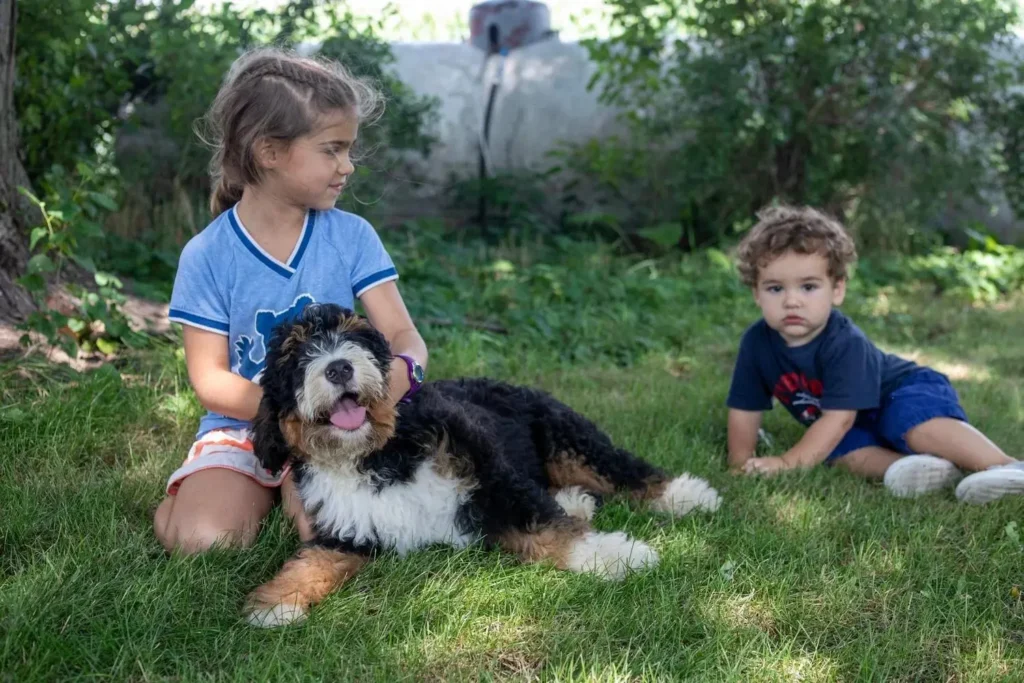
Introducing a Mini Bernedoodle to kids should feel calm and controlled.
Do not place a nervous puppy in the middle of a loud group. Do not ask children to crowd around it.
The dog needs time to study the new people and environment.
Explain the rules before bringing the dog into the room.
Ask the children to sit quietly. Tell them not to call the puppy over again and again. They should avoid staring into its eyes or reaching over its head.
Let the dog choose whether it wants to approach.
A child can gently toss a treat on the floor. This creates a positive experience without forcing physical contact.
The first meeting should stay short. Blue Cross recommends keeping early introductions calm and giving the puppy space to settle after meeting the family.
Never hold the puppy in place while children touch it.
A trapped dog may become frightened. It should always have a safe route away from the interaction.
One calm child is easier than four excited children.
Begin with the child who can follow instructions best. Add other children during later sessions.
Keep toys and food bowls away from the first meeting. These items can create extra excitement or competition.
The child may sit with a book while the puppy explores nearby. The dog learns that children can be calm and predictable.
The word mini can make people think the dog will always stay tiny.
Mini Bernedoodle size is not fully predictable. These dogs are mixed breeds and can inherit different body sizes from their parents.
Some remain easy to carry. Others become strong small-to-medium family dogs.
A Mini Bernedoodle may jump when excited.
Even a friendly dog can knock over a toddler. Its paws may scratch the child’s face or arms.
Teach calm greetings early.
Keep the dog on a leash when visitors arrive. Reward sitting or standing with four paws on the floor.
Children should not run toward the dog when it enters the room. This can raise the dog’s excitement and start chasing.
Child safety works both ways.
A young child may fall onto the dog or pull its ears. The child may step on a paw or hit the dog with a toy by mistake.
Pain can cause even a gentle dog to protect itself.
Create physical space with gates and pens. The dog should have a bed or crate where children are not allowed to follow.
AKC safety guidance says young children should never be left unattended with a dog. This rule applies even when the dog seems friendly and has never shown aggression.
A child may enjoy helping during walks. Yet an adult should hold the main leash.
A Mini Bernedoodle may suddenly pull toward another dog or squirrel. A child could fall or lose control.
Older children can hold a second lightweight leash while an adult keeps the main one. This allows safe participation without giving the child full responsibility.

Training Mini Bernedoodles around children should begin before problems appear.
The dog needs clear skills. The children need clear rules too.
Training only the dog will not create a safe home when children continue to tease or disturb it.
A Mini Bernedoodle should learn its name and recall. It should also understand sitting and leaving it and dropping it.
A mat cue is especially helpful.
Place a mat away from the busiest part of the room. Reward the dog for stepping onto it. Slowly teach it to lie down and remain there.
The mat gives the dog a job during meals or visitors.
Teach the skill when the home is quiet. Do not begin training during a loud birthday party.
Reward the dog when children move through the room and it stays settled.
Give a small treat when it keeps four paws on the floor. Reward it for looking at a running child and then turning back toward the adult.
These calm choices need practice.
AVSAB recommends reward-based training for normal skills and behavior problems. Reward-based methods teach the dog what to do without depending on pain or fear.
Management is part of training.
Use a baby gate when children are eating snacks. Separate the dog during wild indoor games.
Put the dog behind a gate with a safe chew when the children have friends visiting.
This is not punishment. It prevents the dog from practicing jumping or stealing food.
A tired parent cannot closely supervise every second. Safe barriers create a clear break for everyone.
Do not ask a child to correct the dog. An adult should handle training and safety decisions.
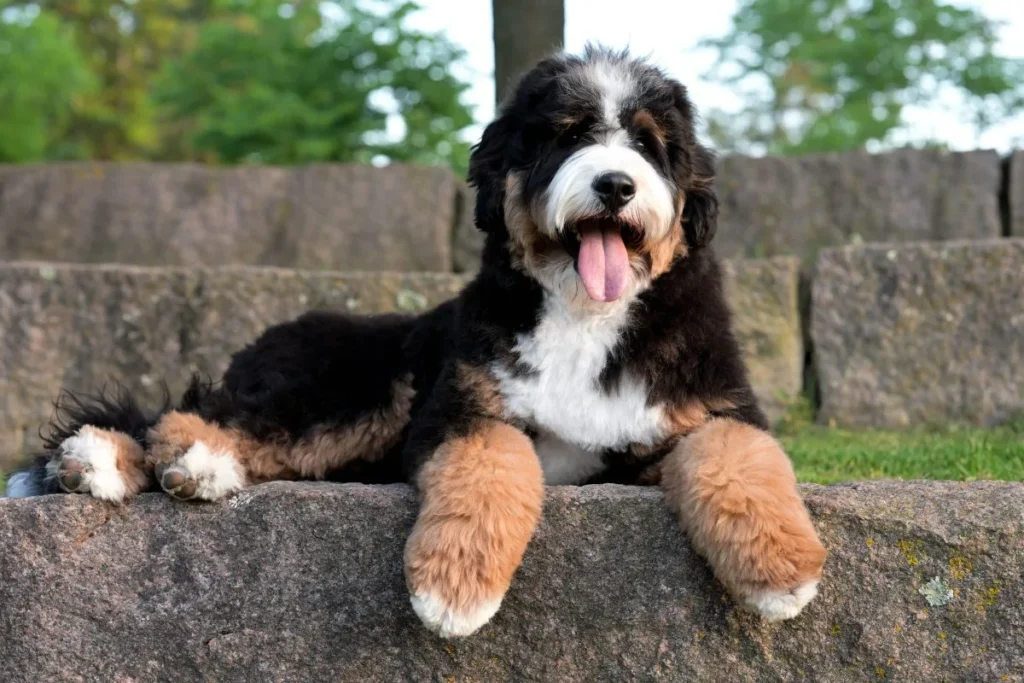
Teaching kids to respect a Mini Bernedoodle is just as important as obedience training.
Children often show love through hugs. Many dogs do not enjoy being squeezed or held tightly.
A dog may tolerate a hug for a while. That does not mean it feels comfortable.
Use short rules that children can remember.
These rules should apply every day.
A child may understand them but still forget during an exciting moment. Adult supervision remains necessary.
Teaching children to notice dog body language and respect space can reduce unsafe interactions.
Demonstrate gentle petting on a stuffed toy first.
Ask the child to use one open hand. The hand should move slowly along the dog’s shoulder or back. Avoid patting the top of the head during early meetings. Do not touch the feet or tail unless the dog already enjoys that handling.
Pet for a few seconds and then stop.
When the dog moves closer it may want more. When it turns away or walks off the interaction should end.
Puppies need a lot of sleep.
A tired puppy may become mouthy and unable to control itself. Children may think the puppy wants more play because it runs or bites.
Adults should notice the pattern.
After activity place the dog in a quiet area with water and a safe chew. Children should not disturb it there.
Playtime and supervision with young children need simple structure.
Free play can quickly become too rough. The child runs. The puppy chases. The child screams. The puppy becomes even more excited. Adults should choose games that keep both sides safe.
A child can toss treats for a simple search game.
Older children can help with short training sessions. They may ask for a seat and then toss one piece of kibble as a reward.
A child may also roll a ball across the floor. Rolling is often safer than waving toys near the face.
Avoid wrestling. Do not let children play chase through the house.
Tug can be safe for older children when the dog knows how to release the toy. An adult should teach and supervise the game first.
Active supervision means the adult is watching the interaction.
The adult should not be cooking in another room or looking at a phone.
Stay close enough to interrupt jumping or grabbing. End the game when the dog becomes stiff or overexcited.
AKC and veterinary behavior guidance stress close adult monitoring during dog-child interactions because even a dog with good past experiences may react when it feels frightened or trapped.
Children and puppies can both become tired.
Set a timer for short play sessions. After a few minutes ask the child to stop and let the puppy rest.
A natural pause keeps excitement from growing too high.
The dog should be able to walk away without being followed.
When the puppy hides under furniture or goes to its crate the game is over.
Choosing a family-friendly Mini Bernedoodle requires more than picking the cutest coat color.
Look at the puppy’s behavior and the parent dogs. Ask how the puppies were raised.
A responsible breeder or rescue should answer questions clearly.
Ask to meet the mother when possible.
Watch how she responds to unfamiliar people and normal sounds. She does not need to jump into every stranger’s lap. She should recover after a mild surprise and accept normal handling.
Ask about the father’s temperament too.
The Bernese Mountain Dog parent should have a stable and good-natured temperament. The Poodle parent should also show confidence and normal social behavior.
Parent temperament cannot promise the puppy’s future. It still gives useful information.
A family puppy should show curiosity without becoming uncontrollably wild.
The boldest puppy may be too demanding for a busy home. The quietest puppy may need extra confidence work.
Watch how the puppy reacts when a new object enters the area. Does it investigate after a short pause? Can it settle after play?
A puppy should not be chosen only because it has a desired coat pattern.
Ask whether the puppy has heard normal household sounds.
Find out whether it has met calm adults and sensible children. Ask whether it has experienced grooming and gentle handling and short periods away from the litter.
Good socialization uses safe and positive exposure. It should not overwhelm the puppy.
A family with toddlers needs a different dog from a family with calm teenagers.
Think about noise and activity. Consider how much time adults can give to exercise and training.
The parents must accept the main responsibility. Children can help with simple jobs but they should not become the dog’s main caregiver. Getting a family dog adds daily work for adults even when children promise to handle everything.
Most behavior problems do not appear without warning.
A dog may begin avoiding children or guarding food. It may freeze when touched or growl when resting.
Do not punish the growl.
A growl is important information. The dog is saying that it feels unsafe or uncomfortable.
Separate the dog and child when the dog shows fixed staring or stiff posture.
Other warning signs include lip lifting and snapping or blocking access to food and toys. Constant hiding around children also shows that the dog is struggling.
Pain can change behavior. A dog with an ear infection or sore joint may react when a child touches it.
Start with a veterinary examination when behavior changes suddenly.
Contact a qualified reward-based trainer when fear or guarding appears.
A veterinary behaviorist may be needed for serious aggression or a bite history.
Do not use a child to test whether the problem is fixed.
Management may include gates and separate feeding and dog-only resting spaces. When adults cannot maintain the safety plan the dog and child should remain separated.
VCA advises strict safety management when a dog shows fear or aggression toward children. A capable adult must supervise because children may not understand or follow every rule.
Mini Bernedoodles can be wonderful family dogs.
Many have a loving nature and enjoy playing or relaxing near children. Their Bernese Mountain Dog side may bring gentleness. Their Poodle side may bring intelligence and an interest in training. Still breed mix alone does not create safety.
Choose a puppy with stable parents and positive early experiences. Introduce the dog to children slowly.
Teach calm greetings and a mat cue. Reward good choices instead of using harsh punishment. Children must learn rules too. They should never pull fur or disturb food or follow the dog into its resting area.
Most important of all is supervision.
Even a friendly Mini Bernedoodle needs an adult nearby during time with young children. Safe gates and separate rest periods can prevent problems before they start. The best family relationship grows from respect on both sides. The dog receives space and clear training. The children learn gentle behavior.
That is how a Mini Bernedoodle and a child can build a safe friendship that lasts for years.