

Mini Bernedoodles have that funny combination that makes people curious about them. They look soft and cuddly, sometimes almost like a stuffed toy, but there can be a pretty busy brain hiding under all that fluffy hair.
So, how smart are Mini Bernedoodles?
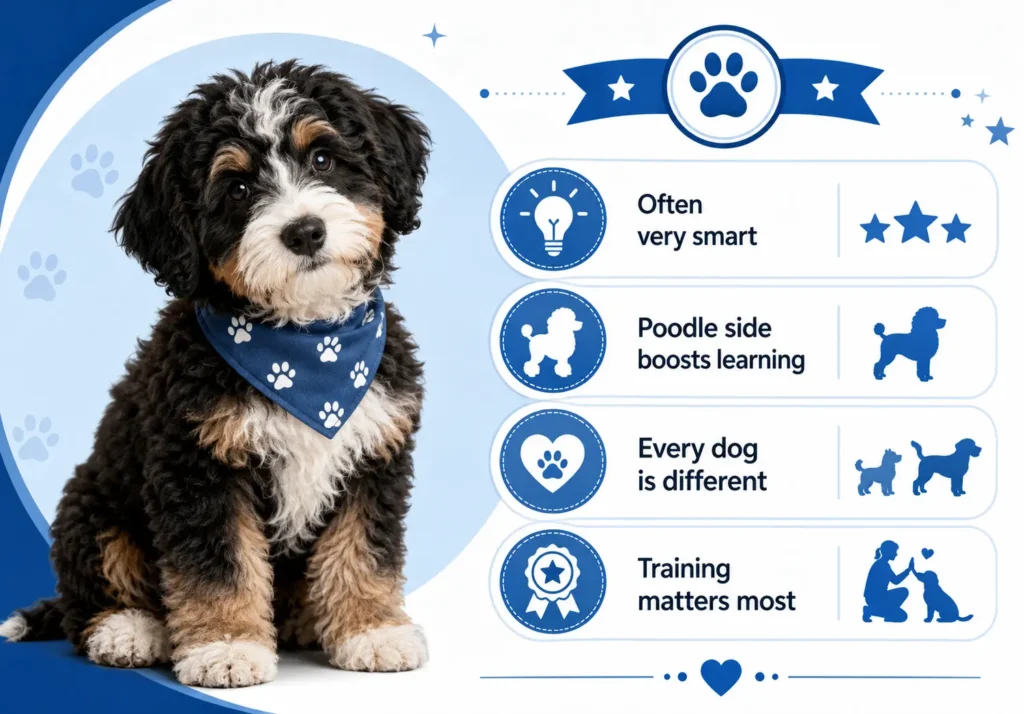
The simple answer is they can be very smart and good learners.
A Mini Bernedoodle comes from Bernese Mountain Dog and Poodle lines. Both parent breeds can learn well, but they don’t always show their smarts in exactly the same way. Poodles have a strong reputation for quick learning, close work with people, and trainability. Bernese Mountain Dogs are also intelligent, people-focused working dogs that can learn obedience and different jobs.
Put those traits together and you may get a dog that learns commands quickly, watches what people are doing, remembers routines, and enjoys figuring things out.
But don’t get too hung up on labels such as “super intelligent.”
Dogs aren’t taking school exams.
One Mini Bernedoodle may learn to “sit” incredibly quickly but get distracted by every bird outside. Another may take a little longer to understand a trick but remember household routines like clockwork. Intelligence, attention, motivation, personality, age, and training all mix together.
Research on dogs also shows that canine intelligence isn’t just one single skill. Dogs can differ in learning, memory, problem-solving, communication with humans, and other mental abilities.
That’s what makes this topic a bit more interesting than simply saying, “Yes, they’re smart.”
Most Mini Bernedoodles have the potential to become good learners.
A big reason comes from their family background.
Poodles are known for being intelligent, attentive, active, and easy to train when people use clear and consistent methods. They were originally working dogs, not just fancy-looking pets. Their history involved retrieving, working with humans, and later performing many different tasks.
Bernese Mountain Dogs bring another kind of working background.
These large dogs historically performed useful jobs such as pulling carts and working around farms. Modern breed guidance describes them as intelligent, willing to work with people, and generally responsive to training.
A Mini Bernedoodle can inherit pieces from both sides.
That’s where things get fun.
Your puppy might pick up the Poodle’s quick learning and curiosity. It may also pick up the Bernese side’s strong attachment to family and willingness to cooperate.
Still, genetics aren’t like mixing two glasses of juice.
You don’t get exactly 50% of every personality trait.
Two puppies from the same litter can act surprisingly differently.
One may stare at you waiting for the next command. The other may understand perfectly well and then decide that sniffing the carpet is today’s main mission.
People often imagine a smart dog doing complicated tricks.
Real-life intelligence can look much simpler.
A smart Mini Bernedoodle may notice that the sound of your keys means you’re leaving. It might learn where treats are kept. It may remember which door leads outside or figure out that sitting calmly gets attention faster than jumping around.
Dogs can form associations between sounds, actions, objects, and outcomes. Research even shows that dogs can tell familiar trained words from unfamiliar sounds, and some dogs can form meaningful links between words and objects.
You might notice signs like:
These little things are often a pretty good indicator of an active brain.
And some of them happen when you aren’t even trying to teach the dog.

Mini Bernedoodles often learn basic commands fairly quickly when training stays clear, short, and rewarding.
“Sit,” “come,” “down,” “wait,” and simple house rules may begin making sense quite early.
Breed guides commonly describe Bernedoodles as quick learners that can handle basic cues, tricks, crate routines, and house training well when owners stay consistent.
But here’s something worth remembering.
There is no magic number of repetitions that every Mini Bernedoodle needs.
You may see claims online saying a certain breed learns a command in exactly five, ten, or fifteen repetitions. Real dogs aren’t that neat.
The difficulty of the command matters.
The puppy’s age matters.
The environment matters.
Even the reward matters.
Try teaching “sit” inside a quiet kitchen and your puppy may look like a little genius.
Try the same command outside while another dog runs past, somebody opens a food bag, and a squirrel shoots across the yard.
Suddenly that university degree disappears.
That’s normal.
This trips up a lot of new dog owners. Your puppy may know what “come” means inside the house but ignore it at the park. That doesn’t necessarily mean the dog forgot.
It means the situation became harder.
Dog trainability depends partly on attention and distractibility, not intelligence alone. An intelligent dog can understand a command but still struggle to focus when the environment becomes exciting. That’s why good training slowly adds distractions.
First, teach the behavior somewhere quiet.
Then practice in another room.
Then maybe the yard.
Later, work around mild distractions.
You build the skill instead of expecting perfection on day one.
Puppies don’t need hour-long classroom sessions.
Actually, those can become pretty useless.
A few minutes of focused learning can work better than dragging training out until the puppy becomes bored. You want the little guy thinking, “Hey, this is fun,” not staring at you like the world’s longest math class has just started.
Stop while things are still going well.
Then come back later.
They can.
But this is another area where we need to avoid making huge claims.
There isn’t strong scientific research showing that Mini Bernedoodles have a special kind of memory that beats every other dog.
What we do know is that dogs in general can use several kinds of learning and memory.
Scientific research on canine cognition studies abilities such as remembering locations, learning associations, communicating with humans, solving problems, and adapting behavior when rules change.
Mini Bernedoodles come from two trainable working backgrounds, so it’s reasonable to expect many of them to do pretty well when owners give them chances to use their brains.
Your dog probably won’t remember things the same way you do. Still, dogs become very good at remembering patterns. Breakfast comes after somebody wakes up.
The leash means walk time.
A certain cupboard means snacks. One particular road leads toward the park. Your shoes plus your jacket plus the keys might mean you’re going somewhere.
After seeing the same pattern enough times, a Mini Bernedoodle may begin reacting before you say anything.
That’s learning.
And yes, owners sometimes accidentally teach things too. Give your puppy attention every time it steals a sock and runs around the room, and you may accidentally create a very successful sock-stealing program.
The dog thinks, “Grab sock, human chases me, brilliant game.” Smart doesn’t always mean convenient.
A simple puzzle can show you a different side of your dog’s mind. Imagine placing a treat under an easy movable cup. At first, the puppy might sniff around.
Then push it.
Maybe paw at it.
Maybe look at you.
Eventually the treat appears.
Repeat the game later and the puppy may reach the answer faster.
Research on dogs looks at similar kinds of learning, persistence, memory, and problem-solving behavior. Scientists have found meaningful differences between individual dogs, which is another reason breed labels can’t tell you exactly how one puppy will perform.
Some Mini Bernedoodles attack a puzzle with full confidence. Others stare at you as if saying, “You hid the food. You fix it.”
Both can still be intelligent dogs.
They’re just using different strategies.

Generally, yes.
Mini Bernedoodles are often considered fairly trainable, especially when they inherit strong people-focused traits from both sides of their family.
Guidance on Bernedoodles describes them as dogs that can quickly learn basic cues and benefit from early, consistent training. Their Poodle background adds a strong trainability influence, while Bernese Mountain Dogs are also known for being willing learners.
That doesn’t mean training is automatic.
A smart puppy can actually create more work when you aren’t consistent.
Why?
Because smart dogs notice patterns.
If jumping on Dad gets ignored but jumping on Mom gets cuddles, the puppy learns something.
If begging at dinner works every third night, guess what?
The dog may keep trying.
Your Mini Bernedoodle doesn’t understand, “We don’t allow begging except when we’re tired on Friday.”
It understands the results.
Reward-based training is the best direction to take.
That means rewarding behaviors you want with things the dog values, such as food, praise, play, or access to something fun.
Current animal-behavior guidance recommends reward-based methods instead of harsh or frightening punishment.
Both Poodles and Bernese Mountain Dogs are also commonly described as dogs that respond well to patient, positive training. Bernese Mountain Dogs can be sensitive, so harsh corrections may be especially unhelpful.
You don’t have to act like a drill sergeant.
Be clear.
Be consistent.
Reward the good stuff.
Repeat.
That’s the boring little secret behind a lot of well-trained dogs.
Mini Bernedoodles can sometimes look stubborn. Maybe you’ve called your dog and it just stands there.
You know the dog knows “come.”
The dog knows you know.
Everybody knows.
Still nothing.
That doesn’t automatically mean low intelligence.
Sometimes motivation is the problem. Sometimes the environment is more rewarding than you are. Sometimes the dog is tired, nervous, confused, or overly excited.
And sometimes, yeah, your fluffy genius has simply found something much more interesting.
Training should make the correct choice worth making.
Genetics matter, but they aren’t the whole story.
Dog cognition research shows that learning ability can vary between individuals and can also be affected by factors such as age, experience, stress, and training history.
Think of intelligence as potential plus experience. A puppy may come with a good brain for learning, but that brain still needs chances to practice.
Here are some of the biggest factors.
| Factor | How It Can Affect Learning |
| Genetics | Can influence temperament, attention, motivation, and natural learning style |
| Age | Puppies are developing quickly; older dogs may learn differently |
| Early socialization | New sights, sounds, people, and safe experiences can build confidence |
| Training style | Clear, reward-based teaching can make learning easier |
| Motivation | A dog learns faster when the reward actually matters to it |
| Exercise | Enough healthy activity can make it easier to settle and focus |
| Mental activity | Games and training give the brain practice |
| Stress | Fear or heavy stress can interfere with learning |
| Sleep and rest | Tired puppies often lose focus quickly |
| Health | Pain or illness may make a normally responsive dog seem distracted |
| Consistency | Clear household rules make patterns easier to understand |
| Environment | Quiet places are easier for new learning than busy areas |
Two Mini Bernedoodles can have completely different personalities.
One may be food crazy. Show a tiny treat and it’s ready to solve world peace.
Another couldn’t care less. That dog might work harder for a ball, praise, or five seconds of chasing a toy. Figure out what your own dog likes. That’s much more useful than blindly following a training guide that treats every puppy the same.
A nervous dog doesn’t learn the same way as a relaxed one. Imagine trying to study while somebody keeps setting off fireworks beside your chair.
Not great.
Dogs can struggle to focus when they’re scared, overwhelmed, or stressed.
Early positive experiences around different surfaces, sounds, safe people, friendly dogs, cars, grooming, and everyday life can help puppies become more comfortable in the world.
Early socialization is considered important for puppy development and behavior. Don’t dump your puppy into frightening situations and call it socialization, though.
The goal is a safe, positive experience.

You don’t need a dog laboratory.
Most of the good stuff can happen right inside your house.
The goal is to give the brain little jobs.
Training itself is mental exercise. So are searching, sniffing, puzzles, learning object names, exploring new safe places, and working out simple problems.
Studies of pet dogs suggest training experience can influence performance on certain cognitive tasks, which gives us another good reason to keep dogs mentally active rather than letting every day look exactly the same.
Simple ways to build learning ability include:
Don’t solve every problem instantly.
Suppose a ball rolls partly under a chair. If the dog can safely reach it, give it a few seconds.
Maybe it tries a paw.
Then its nose.
Then walks around the other side. That tiny struggle can be useful. You don’t want frustration going through the roof, but a little thinking is good.
The same idea works in training.
Give the dog a chance to work out what earns the reward.
This part matters.
You can’t teach twenty tricks and then never walk your dog.
Mini Bernedoodles usually need both.
Movement helps the body.
Sniffing, exploring, and training work the brain.
The exact activity level can vary because mixed dogs may inherit different amounts of energy from their parents. The Poodle background can bring plenty of activity and a need for stimulation, while Bernese Mountain Dogs also benefit from regular exercise and interaction.
Some dogs are ready for another game five minutes after a walk.
Others are already upside down on the couch.
Get to know yours.
This is where online comparisons can get a bit silly. There is not a reliable scientific ranking that says:
Mini Bernedoodle = number 8.
Another small dog = number 12.
Another dog = number 27.
Mini Bernedoodles aren’t a standardized pure breed with a large body of controlled intelligence research behind them, so claiming an exact intelligence rank would be misleading.
Their Poodle side certainly brings strong learning potential. Poodles frequently appear among highly trainable dog breeds, and research and breed guidance describe them as fast learners that work closely with people.
But that doesn’t prove every Mini Bernedoodle is smarter than every Beagle, Terrier, Spaniel, or other small dog.
Dog intelligence comes in different forms.
A dog bred for close teamwork with humans may look smarter during obedience training.
Another dog may show more independence.
A scent-driven dog may completely ignore your repeated “sit” while following a smell that you can’t even detect.
From the dog’s point of view, it might be doing exactly what its brain was built to do.
Trainability and intelligence aren’t the same thing. Breed history, instinct, motivation, distractibility, personality, and training methods can all affect how smart a dog appears to us.
Owners sometimes want the smartest dog possible. But think about what that actually means. A very clever dog can learn to “sit” quickly.
Great.
It can also learn that touching the kitchen cabinet makes you look over. Then touching it twice makes you stand up. Then whining gets you moving faster.
Congratulations.
Your dog just trained you.
Smart dogs need useful things to do with that brain. Otherwise they can invent their own entertainment, and their ideas aren’t always fantastic.
A bored Mini Bernedoodle might find socks, paper, shoes, trash, barking, digging, or general household chaos much more interesting than you’d prefer. So the best question isn’t, “Is my Mini Bernedoodle smarter than somebody else’s dog?”
Ask, “Am I giving my dog enough chances to use its brain well?”
That’s a much more useful question.
So, how smart are Mini Bernedoodles?
Pretty smart, in many cases.
They come from two intelligent working backgrounds. Poodles are especially well known for fast learning and trainability, while Bernese Mountain Dogs are people-focused dogs capable of learning different tasks and working closely with humans. A Mini Bernedoodle can inherit a nice mix of those traits.
Many of these little guys can learn household routines quickly. They may pick up basic commands, tricks, potty routines, leash manners, and everyday patterns without too much trouble when training stays clear and consistent.
They may also surprise you with how closely they watch people. Grab your walking shoes and they know what’s coming. Touch the treat jar and suddenly you’ve got full attention.
Say a familiar word and those ears pop up. That’s learning happening in everyday life. Still, don’t expect every Mini Bernedoodle to be a tiny furry genius that obeys every command instantly.